4

Suppose $X = \left(\mathbb{R} \times \{0\}\right) \cup \left(\mathbb{R} \times \{ 1 \}\right) $

We define $$(x, 0) \sim \left( \frac1x, 1 \right),\ \forall x \ne 0 $$

So, the question is, what space do we get under this equivalence relation? I'm having some trouble seeing what space we get. Can someone help me? Thanks

Stefan Hamcke
  • 27,733
ILoveMath
  • 10,694
  • I think that for $x\geq 0$ you glue the line from $1->\infty$ of $\Bbb R\times {0}$ in reverse to the line from $0->1$ of $\Bbb R\times {1}$.same for the line of from $0->1$ of $\Bbb R\times {0}$. do the same for the negatives – Haha Nov 03 '13 at 14:20

3 Answers3

2

Hint: Note that $\mathbb R\to X/\sim$ with $x\mapsto (x,0)$ is an embedding with image $(X/\sim)\setminus\{(0,1)\}$ and $x\mapsto (x,1)$ is an embedding with image $(X/\sim)\setminus\{(0,0)\}$. Do you know another space that comes with two embeddings of $\mathbb R$, both only missing a single point?

I gave away I was thinking about $\mathbb R\mathbb P^1$ in another comment, where the to embeddings are $x\mapsto(x:1)$ and $x\mapsto(1:x)$. So we have a homeomorphism \begin{align*} X/\sim &\longrightarrow \mathbb R\mathbb P^1 \\ \overline{(x,1)} &\longmapsto (x:1) \\ \overline{(x,0)} &\longmapsto (1:x) \end{align*} This is well defined since $(x:1)=(1:1/x)$ for $x\neq 0$. The final step is to note that $\mathbb R\mathbb P^1\cong S^1$.

Christoph
  • 24,912
1

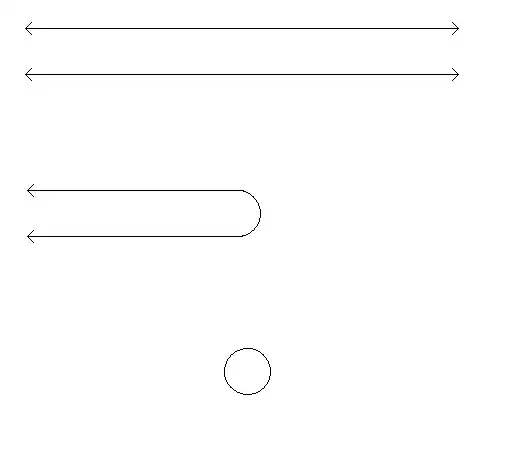
Let's actually try to picture the process, one piece at a time. To start with, we have two copies of the real line, one above the other. We take the interval $[1,\infty)$ on the upper line and glue it in reverse to the interval $(0,1]$ on the lower line, and we take the interval $(1,\infty)$ on the lower line and glue it in reverse to the interval $(0,1)$ on the upper line. Next, we'll glue the interval $(-\infty,-1]$ on the upper line in reverse to the interval $[-1,0)$ on the lower line, and glue the interval $(-\infty,-1)$ on the lower line in reverse to the interval $(-1,0)$ on the upper line. A rough sketch of this three-stage process is below.

enter image description here

Cameron Buie
  • 102,994
1

Consider the map $f:\Bbb R\times\{0\}\to S^1,\ f(x)=\exp\left(i\pi\frac x{1+|x|}\right)$, which wraps the real line around the circle, missing only the point $(-1,0)$. Then consider the map $g:\Bbb R\times\{1\}\to S^1,\ g(x)=\exp\left(i\pi\left(1-\frac x{1+|x|}\right)\right)$. These two maps induce a map $F:X\to S^1$ which send two point $(x,s)$, $(y,t)$ to the same image in $S^1$ if and only if $(x,s)=(x,0),\ x\ne0$ and $(y,t)=(1/x, 1)$. So it induces a continuous bijection $\tilde F$ from $X/\sim$ to $S^1$. Since $f$ and $g$ are open maps, so is $F$, hence $\tilde F$ is a homeomorphism.

Stefan Hamcke
  • 27,733
  • Since we already spoiled the space is homeomorphic to $S^1$, wouldn't it be more elegant to construct a homeomorphism to $\mathbb R\mathbb P^1$ by sending $(x,1)$ to $(x:1)$ and $(x,0)$ to $(1:x)$? That's what I was aiming at with my hint. – Christoph Nov 03 '13 at 14:56