2

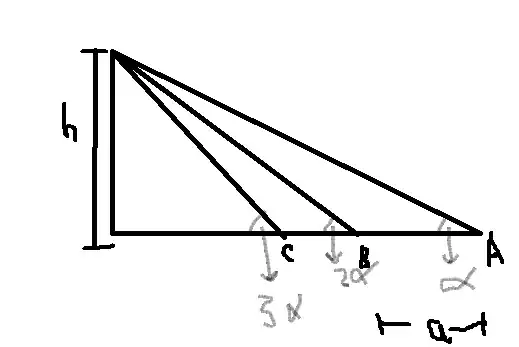
How do I solve this question? The angles of elevation of the top of a pole from three points A,B and C in a straight line(in the horizontal plane) through the foot of the pole are α, 2α and 3α respectively. If AB = a, then the height of the pole is :

  1. a sin(α)
  2. a sin(2α)
  3. a tan(α)
  4. a sin(3α) I think the figure of the problem must be this but I may be wrong: enter image description here
The correct answer is (2).

1 Answers1

2

Let's call the foot of $h$ $D$ for the sake of clarity. Since $a=\overline{AD}-\overline{BD}$, and $\tan{2\alpha}=\frac{h}{\overline{BD}}$, $\tan{\alpha}=\frac{h}{\overline{AD}}$, we can say $$ \frac{h}{tan{\alpha}}-\frac{h}{\tan{2\alpha}}=a $$ By the tangent double angle formula, $\tan(\theta+\psi)=\frac{\tan{\theta}+\tan{\psi}}{1-\tan{\theta}\tan{\psi}}$. It follows that $$\begin{align} h\left(\frac{\tan{2\alpha}-\tan\alpha}{(\tan\alpha)(\tan{2\alpha})}\right)&=a \\ h\left(\frac{\frac{2\tan\alpha}{1-\tan^2\alpha}-\tan\alpha}{(\tan\alpha)\left(\frac{2\tan\alpha}{1-\tan^2\alpha}\right)}\right)&=a \\ h\left(\frac{\frac{2}{1-\tan^2\alpha}-1}{(\tan\alpha)\left(\frac{2}{1-\tan^2\alpha}\right)}\right)&=a \\ h\left(\frac{1+\frac{\tan^2\alpha-1}{2}}{\tan\alpha}\right)&=a \\ h\frac{\tan^2\alpha+1}{2\tan\alpha}&=a \\ h\frac{\sec^2\alpha}{2\tan\alpha}&=a \\ \frac{h}{2\sin\alpha \cos\alpha}&=a \\ h&=a\sin{2\alpha} \end{align}$$

Tim Ratigan
  • 7,247