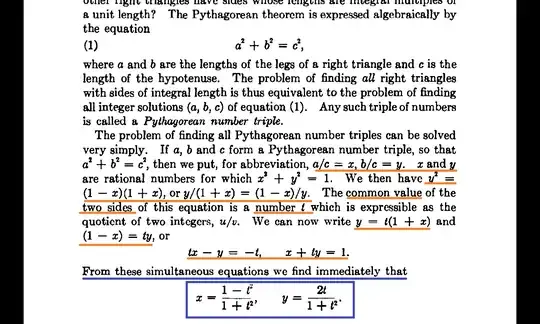
I am reading "What Is Mathematics? An Elementary Approach to Ideas and Methods" And I am stuck here, I don't get it. I have posted a screen shot underlining what my doubt is..
I dont get it when the author says while the pythagoras theorem is : $a^2 + b^2 = c^2$ and then he says $x=a/c$ and $y=b/c$ and then the equation should be according to me , $ax+by=c$.. right?? but the author writes y^2 = (1-x)(1+x)
Which I think may have came from something like $x^2 + y^2 = 1$ $y^2= 1^2 + x^2$ $y^2= (1+x)(1-x)$ (since $a^2 + b^2 = (a+b)(a-b)$ )
but I dont get it where did that x^2 + y^2 = 1 came from ?? Is it that author assumed that x=a/c and y=b/c and then stoped talking about pythagoras theorem and started talking on x^2 + y^2 = 1???
and then further he introduces a number t.. i don't get it how it got converted into y=t(1+x) and (1-x)=ty ???
Can please someone help?
also , while i was writing the question it clicked me that if: x=a/c (i.e. opposite upon hypotenuse means x is sin ) y=b/c (i.e. adjacent upon hypotenuse means y is cos) therefore x^2 + y^2 = 1 (sin^2 + cos^2 = 1)
but then if i assume i am right about the sin cos thing then how come the last step is derived ?? (the one in blue color underline and box) also that as per me x is sin , but the formula in that book is of cos2x? when t=tanx??
so m lil confused .. if you want any more clean way of me asking my doubt then do tell me i will rephrase the entire question .. :)