Let A = {1,2}, B={2,3} and C={3,1} so |A| = |B| = |C| = 2. Then A $\cap$ B $\cap$ C = $\emptyset$, but $$A \cup B \cup C = \{1,2,3\} \implies |A \cup B \cup C|=3 \not= |A| + |B| + |C|$$
When you apply inclusion-exclusion in this case, you also need to consider the sizes of |A $\cap$ B|, |B $\cap$ C| and |C $\cap$ A|. I suspect the cause of the confusion is that you have generalized from the two set case, in a way that doesn't work in the three set case. The "sum principle" you refer to, is exactly the inclusion-exclusion principle applied to only two sets:
$$|A \cup B| = |A| + |B| - |A\cap B| $$
If and only if A and B are mutually exclusive, so $A \cap B = \emptyset $, we have:
$$|A \cup B| = |A| + |B| $$
But when three sets are involved, the inclusion-exclusion principle gives:
$$|A \cup B \cup C| = |A| + |B| + |C| - |A\cap B| - |B\cap C| - |C\cap A| + |A\cap B\cap C| $$
You can check why this works visually. Can you see why each subset of A $\cup$ B $\cup$ C is only counted once? For instance the part of A that does not intersect with B or C (i.e. $A \cap B' \cap C'$) is only counted by the first term. More complicated is $A \cap B \cap C$ (in the middle), which is included by the first three terms so it starts off as triple-counted. The next three terms take it away again, and the final term adds it back on, so by the end it has been counted once only.
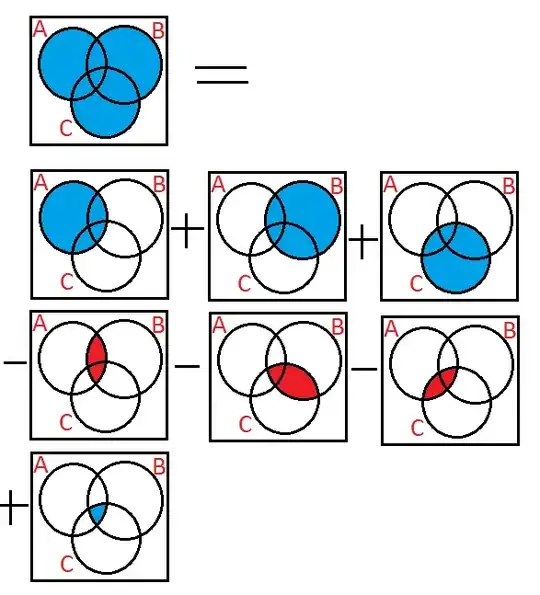
Knowing that $A\cap B\cap C = \emptyset $ would only reduce this to:
$$|A \cup B \cup C| = |A| + |B| + |C| - |A\cap B| - |B\cap C| - |C\cap A|$$
In my example $A\cap B=\{2\}$, $B\cap C=\{3\}$ and $C\cap A=\{1\}$ which all have cardinality one. The formula correctly gives $3 = 2 + 2 + 2 - 1 -1 -1$.


