1

I know how to prove that the Riemann integral of a function does not change if one point of the function is changed. However, extending that result to a finite set by use of induction is something I have struggled to prove. I just need a hint as to how I should start off the proof. Looking forward to an exchange of ideas. An answer I found for a single point is given below.
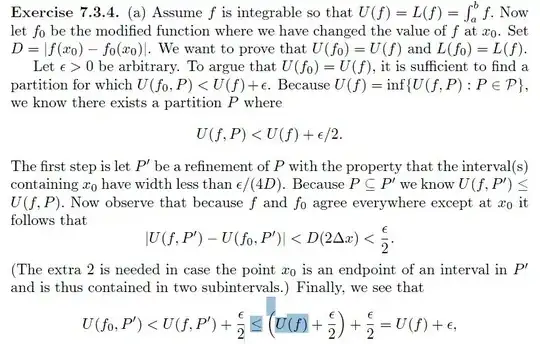
enter image description here

Heisenberg
  • 3,227
  • 1
    No partition needed, the result for $n=1$ implies the result for $n=2$, which implies $\dots$. But if you really want to, basically replace $\epsilon$ everywhere by $\epsilon/n$, and $D$ replaced by $\max D_i$. That basically does not use induction. – André Nicolas Nov 05 '13 at 18:24
  • @AndréNicolas Thanks! – Heisenberg Nov 05 '13 at 18:29

2 Answers2

0

Now, let $f_1$ be equal to $f_0$, except at $x_1$; you know that the integral of $f_1$ is the same as that of $f_0$ by the above argument (so then it is also the same as $f$!).

Then, let $f_2$ be equal to $f_1$, except at $x_2$, etc., etc.

BaronVT
  • 13,613
  • What I need to do is to assume that for n points the result is true and extend it to n+1 points. I am not sure as to how to exactly prove this. How to form the partition etc – Heisenberg Nov 05 '13 at 18:01
  • 1
    Let $f_{n+1}$ be a function that differs from $f$ at $n+1$ points. Now, let $f_n$ be a function that equals $f_{n+1}$ at all but one of those points (so $f_n$ differs from $f$ at exactly $n$ points).

    By your induction assumption the integrals of $f$ and $f_n$ are the same. By the above argument, the integrals of $f_n$ and $f_{n+1}$ are the same (since they only differ at one point). No partitions needed.

    – BaronVT Nov 05 '13 at 18:31
0

Any finite sequence of changes can be decomposed into a sequence of changes one point at a time. The first of these does not change the value of the integral. Then the second doesn't either by the same theorem.

In other words, you assume that n changes have been made, then because you know that a single point being changed (i.e from n changes to n+1) doesn't affect the integral, n+1 changes will also have no effect.

Harry Wilson
  • 1,084