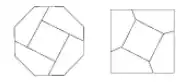
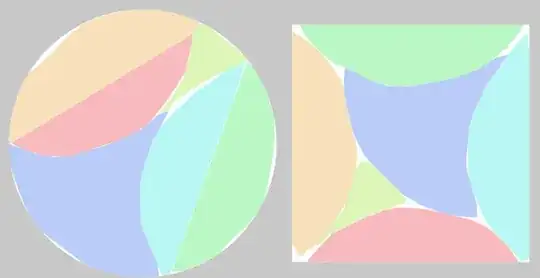
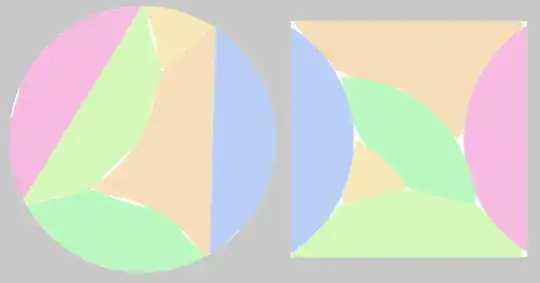
We know that there is no paper-and-scissors solution to Tarski's circle-squaring problem (my six-year-old daughter told me this while eating lunch one day) but what are the closest approximations, if we don't allow overlapping?
More precisely: For N pieces that together will fit inside a circle of unit area and a square of unit area without overlapping, what is the maximum area that can be covered?
N=1 seems obvious: (90.9454%)
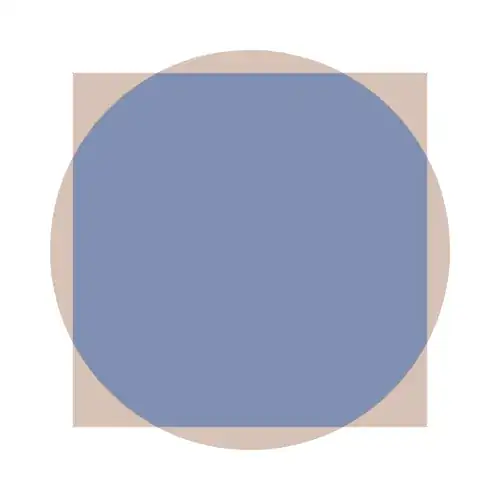
A possible winner for N=3: (95%)
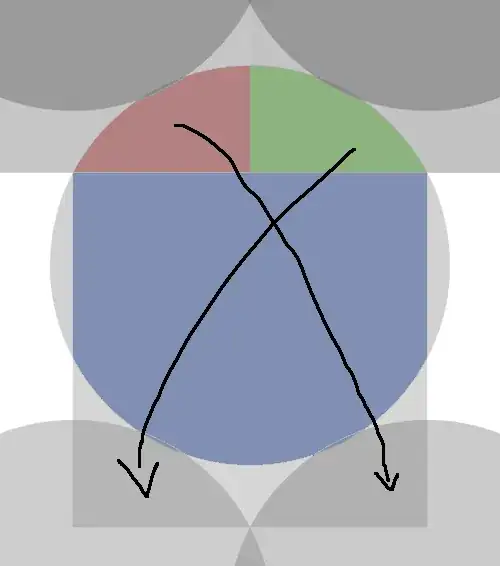
It seems likely that with, say, N=10 we could get very close indeed but I've never seen any example, and I doubt that my N=3 example above is even the optimum. (Edit: It's not!) And I've no idea what the solution for N=2 would look like.
This page discusses some curved shapes that can be cut up into squares. There's a nice simple proof here that there's no paper-and-scissors solution for the circle and the square.