If light is hitting a Parabolic Trough defined by $y=x^2$ at a 60 degree angle from vertical so that the effective cross-section of the modified parabola is paramaterized by: x=t, y=t^2, z=tcot(60). Then how would parallel light rays interact with this new paramaterized shape? Would there be a focus? What methods might be employed to investigate this query?
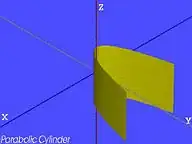
[edit] Thanks to Juan Sebastian Lozano Muñoz for pointing out that it is necessary to "assume that all light to be parallel to the cross section."
 [edit 2]: Thanks to Geoffrey I can easily understand how this works at the vertex, however it is more difficult to visualize/draw at other points, which involve one vertical and two horizontal components. One horizontal component is a result of the incident light rays incoming at angle $\theta$. The other horizontal component is induced by the parametric parabola described by the equations mentioned above. Therefore it would seem possible to remove the first horizontal component using a theoretical trough defined by the parametric equations x=t, y=t^2, z=tcot(60) instead of $y=x^2$. This would need to assume the incident light rays are at angle $\theta = 0$ from vertical in all directions, which is equivalent to solar tracking.

So in the above picture the of the "Parametric plot" the light-rays would be parallel to the y-axis. This 2D problem seems much more manageable. Geoffrey was saying that the focal length remains unchanged after accounting for the horizontal distance due to $\theta$, which I have attempted to remove from the equation. The focal length of $y=x^2$ is $y=\frac{x^2}{4f}$ where $f$ is the focal length. Here $f=\frac 14$. Therefore the focal length of the new curve $f_p=\frac{\frac 14}{cos(\theta)}=\frac{\frac 14}{cos(60)}=\frac{\frac 14}{\frac 12}=\frac 12$ Is there a way to prove this? geometrically and/or more rigorously?

