0

enter image description here

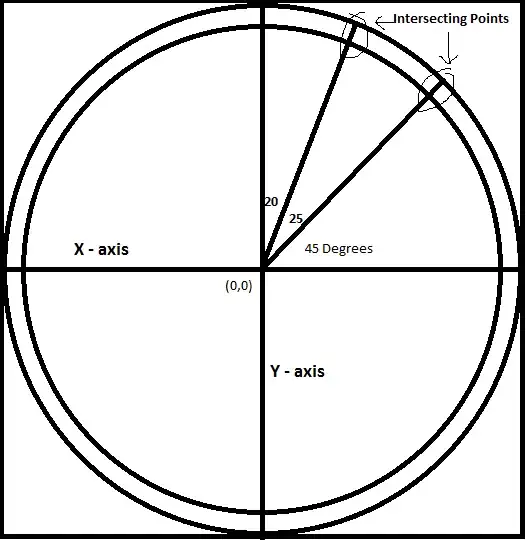
I have a square buy 100 cm in side, now a cricle is drawn taking the center of the square and having radus of 50cm which touches the borders of the square as you can see above, Now imagine another circle within the bigger one, with same center and radius of 45cm.

Also consider the center lines that are passing through to be as the X and Y cordinate (Note the square is 100cm so X and Y axis is also till distance of 100 cm). Now I draw a line from the center of the circle with a specific angle like 20, 25 or 45 degrees such that the line created from center are intersecting points between the two circles.

So my question is how do I get the cordinate values of intersections on the circles using all the above given information ? Is there any formula that I can use here ?

  • You have to solve the system of equations consisting of the circle equations and the line equations. You should get two points for each line/circle pair, and you restrict from there. – Mark Fantini Dec 27 '13 at 05:24
  • For a point a distance $R$ from the origin at an angle $\theta $ as you have drawn it, the coordiantes are given by:$$X=R\cdot \cos (\theta )$$ $$Y=R\cdot \sin(\theta )$$ – DJohnM Dec 27 '13 at 05:28
  • I was abou to answer when User58220's one appeared. I think that this can be done from trigonometric definitions od Sine and Cosine. – Claude Leibovici Dec 27 '13 at 05:30

2 Answers2

0

The conversion from polar coordinates to rectangular does the job. $x=r \cos \theta, y=r\sin \theta$. You know $r$ and $\theta$. $\theta$ is measured couterclockwise from the $+x$ axis.

Ross Millikan
  • 374,822
0

Point on the circle of radius $R$ at an angle $theta$ measured counterclockwise (anticlockwise) from the $x$ axis has coordinates $$ (R \cos \theta, R \sin \theta)$$

Use $R=50$, $R=45$, $\theta =45^\circ$, $\theta = 70^\circ$

user44197
  • 9,730