2

Find the critical points of $f(x,y)=x^y+4xy-y^2-8x-6y$

I found the derivative of the function and got $$f^\prime_x=yx^{y-1}+4y-8 \\ f^\prime_y=\ln x\, x^y+4x-2y-6 $$. I want to find point $(x_0,y_0)$ s.t $f^\prime_x(x_0,y_0)=f^\prime_y(x_0,y_0)=0$. I isolated $x^y$ in both equations and got $x^y=\dfrac{2y+6-4x}{\ln x}=\dfrac{8x-4xy}{y}$, but I can't proceed any further (I get implicit function). How can I find the critical points?

amWhy
  • 209,954
  • 1
    Check that you've got the right function $f(x,y)$. It looks suspiciously like the original formula might have been the much easier $x^2 + 4xy - y^2 - 8x - 6y$. – hardmath Dec 28 '13 at 13:33
  • i wrote only the first derivatives (by x and then by y). i checked again and it's the correct function. –  Dec 28 '13 at 13:47

3 Answers3

2

This function is a pure nightmare ! As said by hardmath, I wonder about a typo such as x^2 instead of x^y.

Eliminating x from the derivative with respect to x, I found one solution which corresponds to y=1.49336 to which corresponds x=1.85682. This can be obtained using the last equation given by hardmath applying Newton.

1

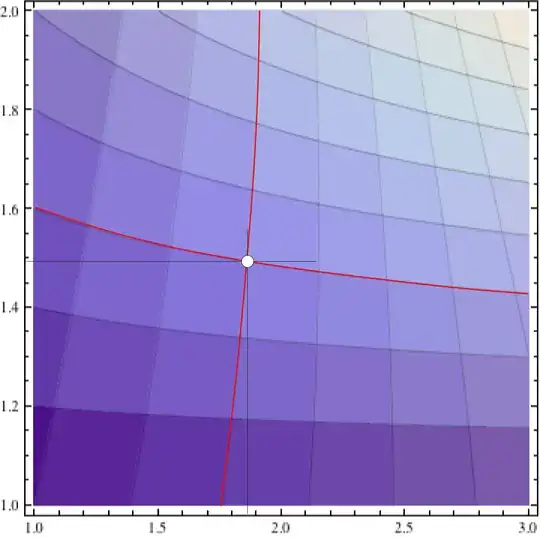
The system $f_x(x,y)=0$, $f_y(x,y)=0$ cannot be solved explicitly. Maybe there are no solutions at all. With the help of Mathematica one can draw contour plots of $f_x$ and $f_y$ in order to obtain hints where there could be a common zero.

The following figure shows an overlay of the contour plots of $f_x$ and $f_y$ in the rectangle $[1,3]\times[1,2]$. The $0$-level-lines are shown in red. Near $(1.85,1.49)$ there seems to be a common zero $(x_0,y_0)$.

enter image description here

With some trial and error I established $$f_x(1.858,1.494)=0.00489,\quad f_y(1.858,1.494)=0.00713\ .$$ If you need more accuracy there are established methods (e.g., Newton's method) for approximating $(x_0,y_0)$ to any desired level of precision.

0

The first equation can be rearranged to give:

$$ x^{y-1} = 8y^{-1} - 4 $$

$$ x = (8y^{-1} - 4)^{\frac{1}{y-1}} $$

$$ \ln x = \frac{\ln(8y^{-1} - 4)}{y-1} $$

and these can in turn be used to eliminate $x$ in the second equation:

$$ (\ln x)x^y + 4x = 2y + 6 $$

$$ [(\ln x) x^{y-1} + 4]x = 2y + 6 $$

$$ \left[ \frac{(8y^{-1} - 4)\ln(8y^{-1} - 4)}{y-1} + 4 \right] (8y^{-1} - 4)^{\frac{1}{y-1}} = 2y + 6 $$

So an equation in one variable only is possible, though obviously this is too complicated to offer much hope of a symbolic solution. It can be simplified somewhat by multiplying through by $(y-1)$ and raising both sides to the $y-1$ power, but it doesn't seem to have a clean answer.

hardmath
  • 37,015
  • 1
    Both suggestions by hardmath [multiply by (y-1) and raise both sides to power (y-1)] are very good in the sense that the terrible singularity at y=1 is removed and the equation to be solved is represented by a quite nice plot. The solution given is previous answers does not change and it is unique. – Claude Leibovici Dec 29 '13 at 06:58