How $\sum_{n=1}^\infty \frac{\mu(n)x^{1/n}}{n}$ is approximately equals x ?
where $\mu(n)$ is mobius function !
How $\sum_{n=1}^\infty \frac{\mu(n)x^{1/n}}{n}$ is approximately equals x ?
where $\mu(n)$ is mobius function !


The short answer is that the first term of your series is simply $x$, the next ones $\;\displaystyle -\frac{\sqrt{x}}2, -\frac{\sqrt[3]{x}}3\,$ and and so on that we may neglect as $x\to \infty$.
Let's expand $x^{1/n}$ in powers of $\ln(x)$ : $\;\displaystyle x^{1/n}=e^{\ln(x)/n}=\sum_{k=0}^\infty \frac {\ln(x)^k}{k!\,n^k}\;$ then : $$\sum_{n=1}^\infty \frac{\mu(n)\;x^{1/n}}{n}=\sum_{n=1}^\infty \sum_{k=0}^\infty\frac{\mu(n)\,\ln(x)^k}{k!\,n^{k+1}}$$ If the exchange of sums is allowed then (using the classical $\sum_{n=1}^\infty \frac{\mu(n)}n=0$) :
$$f(x):=\sum_{n=1}^\infty \frac{\mu(n)\;x^{1/n}}{n}=\sum_{k=0}^\infty\frac{\,\ln(x)^k}{k!}\sum_{n=1}^\infty \frac{\mu(n)}{n^{k+1}}=\sum_{k=1}^\infty\frac{\,\ln(x)^k}{k!\,\zeta(k+1)}$$
The function obtained is clearly related to the derivative of the Gram series : $$G(x):=\sum_{k=1}^\infty\frac{\,\ln(x)^k}{k\,k!\,\zeta(k+1)}=\sum_{k=1}^\infty\frac {\mu(k)}k\operatorname{li}(x^{1/k})$$
and we get : $$f(x)=x\,\ln(x)\;G'(x)$$
The most important term of the Gram expansion is obtained for $k=1$ and since $\,\operatorname{li}'(x)=\frac 1{\ln(x)}\,$ and $\mu(1)=1$ we may see that the most important term is indeed $f(x)\sim x$ for large $x$.
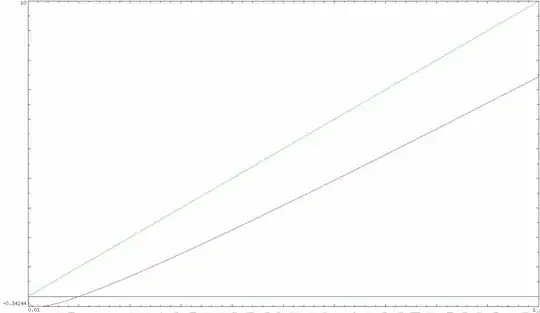
I must add that a plot from $0$ to $10$ shows that the other terms can't be neglected for small values of $x$ (there is a vertical tangent at $0$) :