5

enter image description here

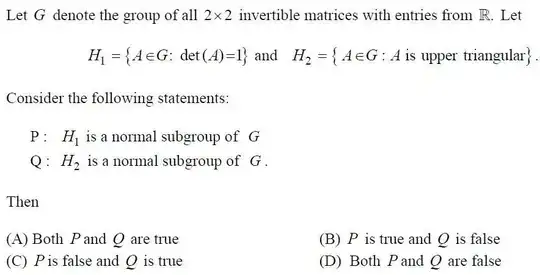
I came across this problem on a math-related facebook group. My answer is B and here is my justification:

$1.) \ H_2 \not\lhd G$

$ \text{Let} \ A=\begin{pmatrix} 2 & 1 \\ 1 & 1 \end{pmatrix} \in G \ \text{,whence} \ $ $A^{-1}= \begin{pmatrix} 2 & 1 \\ 1 & 1 \end{pmatrix}^{-1} = \begin{pmatrix} 1 &-1 \\ -1& 2 \end{pmatrix} .$

$\text{Let} \ B= \begin{pmatrix} 2 & 1 \\ 0 & 2 \end{pmatrix} \in H_2.$ $\text{Then} \ ABA^{-1}= \begin{pmatrix} 0 & 4 \\ -1 & 4 \end{pmatrix} \not\in H_2.$

$2.)\ H_1 \lhd G$

$\forall g \in G\forall h\in H_1: \det(gng^{-1})= \det(g)\det(g^{-1})\det(n)=1$

However, the person who posts this problem said my solution is wrong. May I know what is wrong with my solution? Thank you.

DonAntonio
  • 211,718
  • 17
  • 136
  • 287
  • 2
    Your solution is correct. – Prahlad Vaidyanathan Dec 30 '13 at 06:48
  • I guess in an exam setting you would also be expected to prove that $H_1$ is a subgroup. Checking closure under conjugation comes after that. I would say that your solution is incomplete in that sense, but in facebook setting (whatever that means, I will never be seen there) I wouldn't say it's wrong. I mean, whenever I ask my students to prove that a subset is a normal subgroup, way too many of them forget to first check that it is a subgroup. The question of normality does not arise before you have done that part. – Jyrki Lahtonen Dec 30 '13 at 06:48
  • I've been searching this kinda fb groups. Can you tell me which group it is? – memonto Jan 06 '16 at 00:36

1 Answers1

1

$H_1$ is a normal subgroup because it is the kernel of det.

$H_2$ is not normal because many matrices that are not upper triangular are conjugate to an upper triangular matrix. So, it's not invariant under conjugation.

lhf
  • 216,483