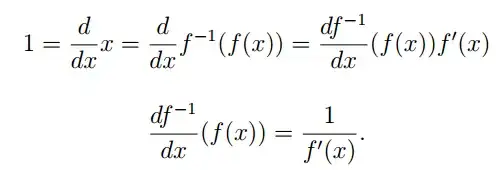
My interpretation of this: $1$ is equal to the derivative of $x$ which is equal to the derivative of the inverse function.
That is incorrect.
$$\frac{d}{dx}f^{-1}(f(x))$$
is the derivative of the function $f^{-1}$ applied to the function $f$. For comparison, the derivative of the inverse function is
$$\frac{d}{dx}f^{-1}(x).$$
Note that a different way of writing would be
$$\frac{d}{dx}f^{-1}(f(x))=\frac{d}{dx}(f^{-1}\circ f)(x),$$
where $\circ$ denotes the composition of two functions. The fact that we have two functions being composed means that we should use the chain rule (see Wikipedia), which is precisely what occurs in the rest of the equations you are asking about.
The main confusion here is that the juxtaposition of two symbols can mean two different things: multiplication of two functions, and application of a function (or operation) to an input.
In the expression
$$\frac{d}{dx}x$$
we apply the operation $\frac{d}{dx}$ to the function $x\mapsto x$ to produce the (constant) function $x\mapsto 1$.
In the expression
$$\frac{d}{dx}f^{-1}(f(x))$$
we apply the operation $\frac{d}{dx}$ to the function $x\mapsto f^{-1}(f(x))$. Since $f^{-1}(f(x))=x$ for every $x$ (by the very definition of $f^{-1}$ being the inverse of $f$), that's why we get
$$\frac{d}{dx}x=\frac{d}{dx}f^{-1}(f(x)).$$
In the expression
$$\frac{df^{-1}}{dx}(f(x))f'(x)$$
we are multiplying two functions, $x\mapsto\frac{df^{-1}}{dx}(f(x))$ and $x\mapsto f'(x)$.
(Remember, to multiply two functions $x\mapsto g(x)$ and $x\mapsto h(x)$, we send each $x$ to the product of their two values, making the function $x\mapsto g(x)\cdot h(x)$.)
In the expression
$$\frac{df^{-1}}{dx}(f(x)),$$
the symbols $\frac{df^{-1}}{dx}$ denote the function that is the derivative of $f^{-1}$, and we are plugging in the value $f(x)$ to this function. Thus,
$$\frac{df^{-1}}{dx}(f(x))$$
is the derivative of $f^{-1}$ at the point $f(x)$ (just like the derivative of $x^2$ at the point $3$ is $6$).
The symbol $f'(x)$ is of course another way of writing the derivative of $f$ at the point $x$, i.e.
$$f'(x)=\frac{df}{dx}(x).$$