$$\int_0^{\infty}\frac{\sqrt[3]{x+1}-\sqrt[3]x}{\sqrt x}dx$$
I tried with $x=u^6$ then some trigonometric function and other thing but I faild
what is your suggest to solve ?
$$\int_0^{\infty}\frac{\sqrt[3]{x+1}-\sqrt[3]x}{\sqrt x}dx$$
I tried with $x=u^6$ then some trigonometric function and other thing but I faild
what is your suggest to solve ?

Is it the exact value of the integral that you are seeking for? Then the answer is
$$ \int_{0}^{\infty} \frac{\sqrt[3]{x+a} - \sqrt[3]{x}}{\sqrt{x}} \, dx = \frac{2}{5}a^{5/6} \beta\left(\frac{1}{6}, \frac{1}{2} \right), \tag{*} $$
where $\beta$ is the beta function. If you are interested in convergence only, you can use the trick
$$ Y - X = \frac{Y^{3} - X^{3}}{Y^{2} + YX + X^{2}}, \quad Y = \sqrt[3]{x+a} \text{ and } X = \sqrt[3]{x}. $$
Solution. Let $I(a)$ denote the integral of (*). Then
$$ I'(a) = \frac{1}{3} \int_{0}^{\infty} \frac{dx}{(x+a)^{2/3}x^{1/2}}. $$
Plugging the substitution $x = a \tan^{2}\theta$, it follows that
$$ I'(a) = \frac{2}{3}a^{-1/6} \int_{0}^{\frac{\pi}{2}} \cos^{-2/3} \theta \,d\theta = \frac{a^{-1/6}}{3} \beta \left( \frac{1}{6}, \frac{1}{3} \right). $$
Since $I(0) = 0$, integrating both sides gives (*).
Justification of some intermediate steps.
We first prove that $I(a)$ is differentiable and Leibniz's integral rule is applicable. Let $a \neq b$. Then
$$ \frac{I(a) - I(b)}{a - b} = \int_{0}^{\infty} \frac{1}{x^{1/3}\{ (x+b)^{2/3} + (x+b)^{1/3}(x+a)^{1/3} + (x+a)^{2/3} \}} \, dx. $$
Let $0 < \delta \leq a, b$ so that in particular both $a$ and $b$ are away from zero. Then the integrand on the right-hand is bounded by the following integrable function:
$$ \frac{1}{3x^{1/2}(x+\delta)^{2/3}}. $$
Thus by dominated convergence theorem, we can let $b \to a$ to obtain the desired result.
Next, by the substitution $x = at$ it follows that $I(a) = a^{5/6}I(1)$. So we can indeed apply the fundamental theorem of calculus as we did in the proof.
Using complex analysis. Consider a keyhole contour $C$ winding $-a$:
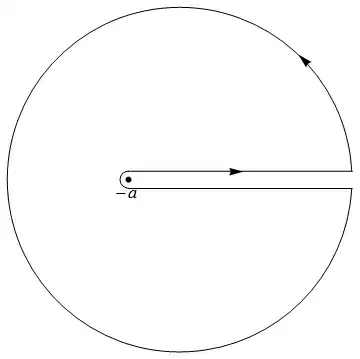
If we denote our integrand as $f(x)$, then with the choice of branch-cut of the complex logarithm as $[0, \infty)$, we have
$$ \int_{C} f(z) \, dz = 0. $$
Letting the outer radius $\to \infty$ and the inner radius $\to 0^{+}$, it follows that
$$ \int_{\infty-i0}^{-i0} f(z) \, dz + \int_{-i0}^{-a-i0} f(z) \, dz + \int_{-a+i0}^{i0} f(z) \, dz + \int_{i0}^{\infty+i0} f(z) \, dz = 0, $$
where $i0$ denotes $i$ times a positive infinitesimal, or to be precise, the limit of $i\epsilon$ as $\epsilon \to 0^{+}$. Simplifying, it follows that
$$ I(a) = \frac{e^{2\pi i/3} + 1}{i (e^{2\pi i/3} + 1)} \int_{0}^{a} \frac{\sqrt[3]{a-x}}{\sqrt{x}} \, dx = \sqrt{3} \int_{0}^{a} \frac{\sqrt[3]{a-x}}{\sqrt{x}} \, dx. $$
Now with the substitution $x = at$, the right-hand side simplifies in terms of beta function.

$\newcommand{\+}{^{\dagger}}% \newcommand{\angles}[1]{\left\langle #1 \right\rangle}% \newcommand{\braces}[1]{\left\lbrace #1 \right\rbrace}% \newcommand{\bracks}[1]{\left\lbrack #1 \right\rbrack}% \newcommand{\ceil}[1]{\,\left\lceil #1 \right\rceil\,}% \newcommand{\dd}{{\rm d}}% \newcommand{\down}{\downarrow}% \newcommand{\ds}[1]{\displaystyle{#1}}% \newcommand{\equalby}[1]{{#1 \atop {= \atop \vphantom{\huge A}}}}% \newcommand{\expo}[1]{\,{\rm e}^{#1}\,}% \newcommand{\fermi}{\,{\rm f}}% \newcommand{\floor}[1]{\,\left\lfloor #1 \right\rfloor\,}% \newcommand{\half}{{1 \over 2}}% \newcommand{\ic}{{\rm i}}% \newcommand{\iff}{\Longleftrightarrow} \newcommand{\imp}{\Longrightarrow}% \newcommand{\isdiv}{\,\left.\right\vert\,}% \newcommand{\ket}[1]{\left\vert #1\right\rangle}% \newcommand{\ol}[1]{\overline{#1}}% \newcommand{\pars}[1]{\left( #1 \right)}% \newcommand{\partiald}[3][]{\frac{\partial^{#1} #2}{\partial #3^{#1}}} \newcommand{\pp}{{\cal P}}% \newcommand{\root}[2][]{\,\sqrt[#1]{\,#2\,}\,}% \newcommand{\sech}{\,{\rm sech}}% \newcommand{\sgn}{\,{\rm sgn}}% \newcommand{\totald}[3][]{\frac{{\rm d}^{#1} #2}{{\rm d} #3^{#1}}} \newcommand{\ul}[1]{\underline{#1}}% \newcommand{\verts}[1]{\left\vert\, #1 \,\right\vert}$ $\ds{\int_{0}^{\infty}{\root[3]{x + 1}- \root[3]{x} \over \root{x}}\,\dd x:\ {\Large ?}}$
\begin{align} &\int_{0}^{\infty}{\root[3]{x + 1}- \root[3]{x} \over \root{x}}\,\dd x= \int_{0}^{\infty}{1 \over \root{x}}\ \overbrace{% \bracks{{1 \over 3}\int_{0}^{1}\pars{\mu + x}^{-2/3}\,\dd\mu}} ^{\ds{\root[3]{x + 1}- \root[3]{x}}}\ \dd x \\[3mm]&={1 \over 3}\int_{0}^{1}\dd\mu\, \int_{0}^{\infty}{x^{-1/2} \over \pars{\mu + x}^{2/3}}\,\dd x ={1 \over 3}\ \overbrace{\int_{0}^{1}\dd\mu\,\mu^{-1/6}}^{\ds{6 \over 5}}\ \int_{0}^{\infty}{x^{-1/2} \over \pars{1 + x}^{2/3}}\,\dd x \\[3mm]&={2 \over 5}\int_{0}^{\infty}{x^{-1/2} \over \pars{1 + x}^{2/3}}\,\dd x \tag{1} \end{align}
With $\ds{\pars{t \equiv {1 \over 1 + x}\quad\iff\quad x = {1 \over t} - 1}}$, $\pars{1}$ is reduced to: \begin{align} &\color{#00f}{\large% \int_{0}^{\infty}{\root[3]{x + 1}- \root[3]{x} \over \root{x}}\,\dd x}= {2 \over 5}\int_{1}^{0}t^{2/3}\pars{1 - t \over t}^{-1/2}\, \pars{-\,{\dd t \over t^{2}}} \\[3mm]&={2 \over 5}\int_{0}^{1}t^{-5/6}\pars{1 - t}^{-1/2}\,\dd t =\color{#00f}{\large{2 \over 5}\,{\rm B}\pars{{1 \over 6},\half}} \end{align}
where ${\rm B}\pars{x,y}$ is the Beta Function.
