1

$\displaystyle w = \int_0^\infty r\; J_\mu(ar)\;J_\theta(br)\; \text{d}r $

I'd like to solve this integral ,where a and b are real and positive constant. any information regarding this integral help me alot.

darksky
  • 507
pali
  • 11

1 Answers1

0

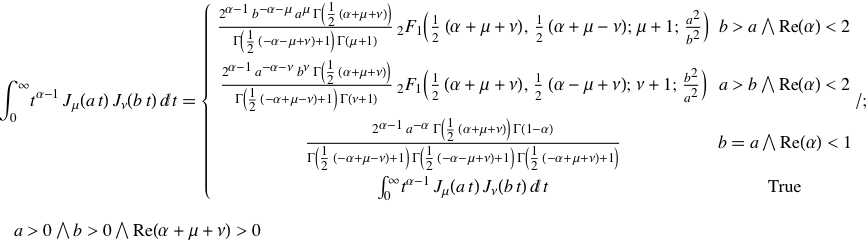
WolframAlpha gives the integral (care to not confuse $a$ and $\alpha$ in the formula).
http://functions.wolfram.com/Bessel-TypeFunctions/BesselJ/21/02/02/0001/MainEq1.L.gif

In case of $r$ tending to infinity the function to be integrated doesn't tends to $0$ (equivalent shown below). So, the integral in not convergent : it contains a sinusoidal component.

If we deduct this non convergent component from the integral, the calculus at limit will be possible and the formula given for $\alpha<2$ should probably be extended to $\alpha=2$ (to be checked, I didn't it).

enter image description here

JJacquelin
  • 66,221
  • 3
  • 37
  • 87
  • 1
    Thank u very much sir for your reply. – pali Apr 18 '14 at 09:22
  • the integration you have attached is it true for alpha= 2, actually i need that. kindly give me your advice . – pali Apr 22 '14 at 06:45
  • For $\alpha = 2$ the integral is not convergent on the upper boundary ( $r$ tending to infinity) – JJacquelin Apr 22 '14 at 07:14
  • is there any process or approximation for solving this integration or it is totally invalid for (r tending to infinite value) – pali Apr 22 '14 at 07:33
  • See a comment in addition to my first answer. – JJacquelin Apr 22 '14 at 07:58
  • In the above mentioned integration using asymptotic form of Bessel function, i need to do the integration from 0 to infinite. but the above mentioned integration is indefinite. how to do the integration from 0 to infinite. – pali May 01 '14 at 11:12
  • Unfortunately, needing something doesn’t imply that is possible. Many impossible things are needed without being obtained, of course. It was proved that the integral is NOT convergent when $r$ tends to infinity. That is clearly visible from the asymptotic formula given above. So, instead of trying to do what is impossible to do, it should be probably more valuable to study the model from which the integral is coming from and to try to understand what is the meaning of the sinusoidal component which causes the integral to be not convergent. – JJacquelin May 07 '14 at 17:51
  • thank you. your replies help me a lot. Thank you again – pali May 09 '14 at 07:17
  • I have checking many times but exactly this integration is coming from my model all the time.Suppose nu=0, and i am working in cylindrical coordinate, If i expand this J_0(br) as sin(br)/br, and putting in the upper integration and the integration will give a finite value.the process for is right? – pali May 09 '14 at 09:16
  • I don't understand << expand J_0(br) as sin(br)/br >>. What do you mean ? The asymptotic expansion of J_0(br) is not sin(br)/br. It is (sin(br)+cos(br))/sqrt(pi*br). The most important point is that there is no r at denominator, but sqrt(r). – JJacquelin May 09 '14 at 09:43
  • @ JJacquelin ,Actually i have found in one paper that someone approximate this J_0(br) as sin(br)/br, which they called as sperical bessel function.From there i put this form. – pali May 09 '14 at 09:51
  • @ JJacquelin ,i want to mean that i take this approximation form of J_0(br)=sin(br)/br, and putting this form in above said integral, then it is possible to integral it. But i dont know is it ok or not? – pali May 09 '14 at 09:56
  • Take care to not confuse Spherical Bessel functions (symbol lower case letter j ) with Bessel function of the first kind (symbol upper case letter J) :http://mathworld.wolfram.com/BesselFunctionoftheFirstKind.html http://mathworld.wolfram.com/SphericalBesselFunctionoftheFirstKind.html In the original wording of your question, you use the symbol for the Bessel function of the first kind. If your question concerned spherical Bessel functions, this is very different. Formulas are different and conditions of convergence for the integrals are different. – JJacquelin May 09 '14 at 10:25
  • Make clear if you use in your model the usual Bessel functions http://mathworld.wolfram.com/BesselFunctionoftheFirstKind.html or the Spherical Bessel functions http://mathworld.wolfram.com/SphericalBesselFunctionoftheFirstKind.html – JJacquelin May 09 '14 at 10:36