4

let $2\le a\le 13,a\in R$,and $x\in R$,show that: $$|1+x|^a\ge 1+ax+\dfrac{1}{1000}|x|^a\tag{1}$$

My try: let $$f(x)=|1+x|^a-1-ax-\dfrac{1}{1000}|x|^a$$

and since if $x>-1$,then $$|1+x|^a=(1+x)^a=1+ax+\dfrac{a(a-1)}{2}x^2+\cdots+x^a$$ and I fell this is nice reslut.because it is well konw this follow Bernoulli inequality

$$(1+x)^a\ge 1+ax,x>-1,a>1$$ But my inequality is strong than this .and I use computer test found this inequality $(1)$ is true.and I can't prove it.

BY the way I found in china book have this
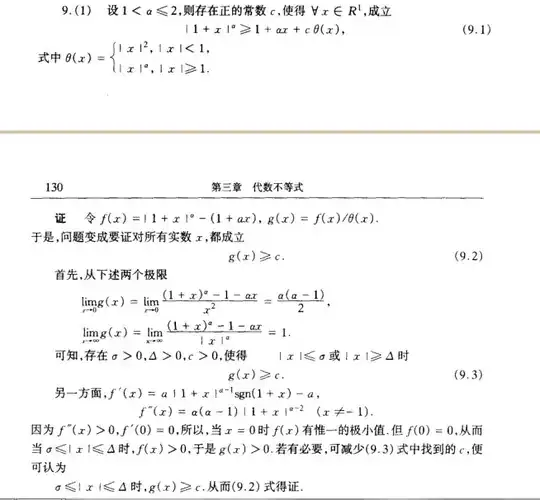
enter image description here Thank you for you help

math110
  • 93,304
  • What is the problem about the proof in your book ? –  Apr 13 '14 at 11:49
  • in china book,http://item.jd.com/10192786.html, and you can download at http://ishare.iask.sina.com.cn/f/23089172.html – math110 Apr 13 '14 at 13:25

2 Answers2

1

Here is a partial answer : I show below that inequality (1) holds when $x\geq 0$ or $x \leq c_1=-\frac{1}{1-\big(\frac{1}{1000}\big)^{\frac{1}{13}}}$ (note that $c_1 \approx -2.42 \ldots$).

Let $g(x)=(1+x)^a-1-ax-x^a$ for $x\geq 0$. Then $g'(x)=a(1+x)^{a-1}-a-ax^{a-1}$, $g''(x)=a(a-1)\big((1+x)^{a-2}-x^{a-2}\big)$, so $g'$ is increasing, and hence $g'(x) \geq g'(0)=a(a-1) >0$, so $g$ is increasing, and hence $g(x) \geq g(0)=0$. So when $x\geq 0$ we have $|1+x|^a \geq 1+ax+|x|^a$, which is stronger than (1).

Next, if $x\leq c_1$ then $|x| \geq |c_1|$, $1-\frac{1}{|x|}\geq 1-\frac{1}{|c_1|}=\big(\frac{1}{1000}\big)^{\frac{1}{13}}$, so $\bigg(1-\frac{1}{|x|}\bigg)^a \geq \frac{1}{1000}$. It follows that $|1+x|^a \geq \frac{1}{1000}|x|^a$, which is also stronger than (1).

Ewan Delanoy
  • 61,600
-1

The value of the function in 0 is 0 for every a. The function is continuous, so you could do the derivative and use binomial theorem to prove that for every x > 0 is positive and for every x < 0 is negative.

EDIT: https://i.stack.imgur.com/gFhhD.jpg