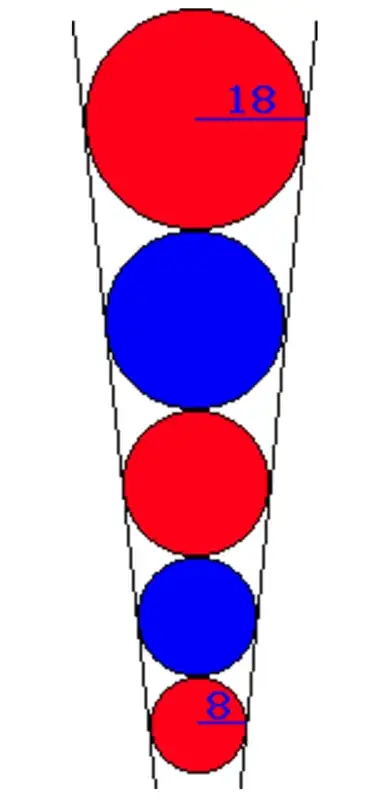
Since I'd never seen the similarity argument, I decided to work one out.
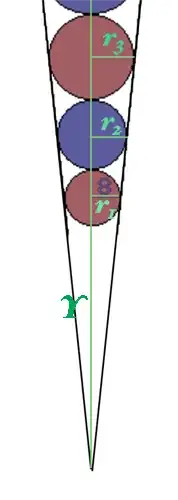
Following the "walls" of the cone to its apex, we can construct similar triangles using one wall and the symmetry axis of the cone. We will call the distance from the apex to the surface of the smallest sphere $ \ Y \ $ , and the radii of the three smallest spheres $ \ r_1 \ , \ r_2 \ , \ $ and $ \ r_3 \ $ . (It will be sufficient to work with just the first three spheres, since the argument is easily extended to any number of spheres in a "stack".)
Since the cone is the result of revolution of a straight line, the "slope" of the wall relative to the symmetry axis is constant (this is also the tangent value for half of the "opening angle" of the cone). This permits us to describe similar triangles, for which this tangent value is
$$ \frac{r_1}{Y \ + \ r_1} \ = \ \frac{r_2}{Y \ + \ 2r_1 \ + r_2} \ = \ \frac{r_3}{Y \ + \ 2r_1 \ + 2r_2 \ + \ r_3} \ \ . $$
From pairing the first two ratios, we have
$$ r_1 Y \ + \ 2 \ r^2_1 \ + \ r_1 r_2 \ = \ r_2 \ Y \ + \ r_1 r_2 \ \ \Rightarrow \ \ Y \ (r_2 - r_1) \ = \ 2 \ r_1^2 \ \ . $$
Pairing the second two ratios, and using our result for $ \ Y \ $ , we then obtain
$$ r_2 \ Y \ + \ 2 \ r_1 r_2 \ + \ 2 \ r_2^2 \ + \ r_2 r_3 \ = \ r_3 \ Y \ + \ 2 \ r_1 r_3 \ + \ r_2 r_3 $$
$$ \Rightarrow \ \ r_2 \ \left( \frac{2 \ r_1^2}{r_2 \ - \ r_1} \right) \ + \ 2 \ r_1 r_2 \ + \ 2 \ r_2^2 \ = \ r_3 \ \left( \frac{2 \ r_1^2}{r_2 \ - \ r_1} \right) \ + \ 2 \ r_1 r_3 $$
$$ \Rightarrow \ \ 2 \ r_1^2r_2 \ + \ 2 \ r_1 r_2^2 \ - \ 2 \ r_1^2r_2 \ + \ 2 \ r_2^3 \ - \ 2 \ r_1 r_2^2 \ = \ 2 \ r_1^2r_3 \ \ + \ 2 \ r_1 r_2 r_3 \ - \ 2 \ r_1^2 r_3 $$
[multiplying through by $ \ r_2 \ - \ r_1 \ $ and canceling like terms]
$$ \Rightarrow \ \ 2 \ r_2^3 \ = \ 2 \ r_1 r_2 r_3 \ \ \Rightarrow \ \ r_2^2 \ = \ r_1 r_3 \ \ . $$
So our intuition concerning a scaling argument is correct, and the geometric mean relation between radii (and so of surface areas and volumes) of contiguous spheres follows from the walls of the cone having constant slope and the spheres being in direct contact with one another.