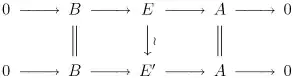
You don't need projectivity of $E$ because you have sufficiently many push-out diagrams and short exact sequences around.
Let us fix the notation first. Form the push-out under $i$ and $f$ to obtain the diagram
    i       i'
B >---> E --->> A
|       |       |
|f      |f'     |1
V   j   V   j'  v
C >---> P --->> A
and form the push-out under $i$ and $g$ to obtain the diagram
    i       i'
B >---> E --->> A
|       |       |
|g      |g'     |1
V   k   V   k'  v
C >---> Q --->> A.
We want to show that the extensions C >-> P ->> A and C >-> Q ->> A are equivalent if and only if there exists a morphism m: E -> C such that mi = g - f.
To say that C >-> P ->> A and C >-> Q ->> A are equivalent is to say that there is an isomorphism l: P -> Q such that
    j       j'
C >---> P --->> A
|       |       |
|1      |l      |1
V   k   V   k'  v
C >---> Q --->> A
commutes. Consider the morphism g'-lf': E -> Q. We have
k'(g'-lf') = k'g' - k'lf' = i' - j'f' = 0
so that (g'-lf') = km for a unique morphism m: E -> C since k = ker k'. Now notice that
kmi = (g' - lf')i = g'i - lf'i = kg - ljf = k (g - f)
so that the fact that k is a monomorphism gives that mi = g-f, as we wanted.
Conversely, suppose there is a morphism m: E -> C such that mi = g-f. Then
kf = k (g - mi) = kg - kmi = g'i - kmi = (g' - km) i
so that we have a commutative square
    i
B >---> E
|       |
|f      |g'-km
V   k   V
C >---> Q
Applying the push-out property of BECP to that square we get a unique morphism l: P -> Q such that k = lj and g'-km = lf' and I claim that the diagram
    j       j'
C >---> P --->> A
|       |       |
|1      |l      |1
V   k   V   k'  v
C >---> Q --->> A
commutes. For the left hand square this is given and for the right hand square notice that
(k'l - j') f' = k'lf' - j'f' = k' (g' - km) - i' = k'g' - i' = 0
and
(k'l - j') j = k'lj = k'k = 0
so that (k'l - j')[j f'] = [0 0] and this implies that k'l-j' = 0 because the morphism [j f']: C+E -->> P is an epimorphism, as BECP is a push-out by hypothesis. It follows from the five lemma that the two extensions C >-> P ->> A and C >-> Q ->> B are equivalent.
It is a good exercise to show that a similar argument applied to an appropriate square (I'll let you find the morphism (?) yourself)
    i
B >---> E
|       |
|g      |(?)
V   j   V
C >---> P
and exploiting the push-out property of BECQ yields a morphism l': Q -> P which is inverse to l: P -> Q.