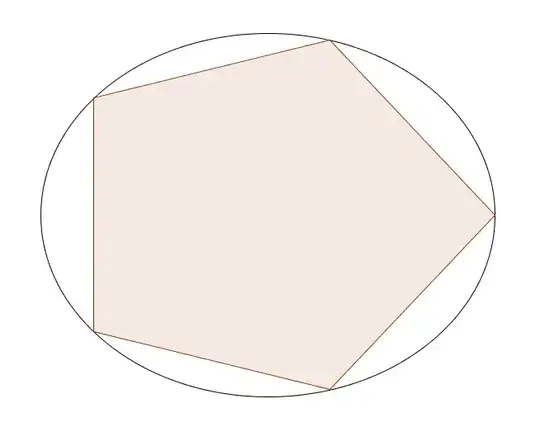
I think this is not true. For a $(3,4)$ pentagon starting at the end of the major axis, I get an area of 28.4032, and at the minor axis I get 28.4020.
Obviously, this is a very small difference; I will try to justify the claim that this is not round off error. I ran my innermost computations with WorkingPrecision set to 100 digits. As a check on my computations, I directly traversed each of the 5 arcs around the ellipse, rather than manually setting the final vertex equal to the initial one; the difference between the initial vertex and the computed position for the final one was of order $10^{-12}$.
In terms of the parametrization $(a \sin \theta, b \cos \theta)$, I get that the vertices are at $\theta$ values of
{0.000000000000, 1.292954985206, 2.443082328571, 3.840102978604, 4.990230321969, 6.283185307175}
{1.570796326795, 2.779128093468, 4.147204875501, 5.277573085264, 6.645649867296, 7.853981633971}
Note that the last entry in each row is almost $2 \pi$ and $5 \pi/2$ respectively, but differs in the last digit given; if the computation were exact, they would be precisely equal.
Let me also give an intuitive explanation of why we expect the variation to be small. Let the arclength parametrization be $(a \sin \theta(t), b \cos \theta(t))$. Then $\theta'(t)$ is proportional to $1/\sqrt{a^2 \cos^2 \theta(t) + b^2 \sin^2(t)}$, which only varies between $1/a$ and $1/b$. It is not that far off from just taking $\theta$ to vary linearly with $t$. For example, if $(a,b)=(3,4)$ and you drive around an elliptical track at a constant rate of $\theta'$, then your minimum and maximum speed are in a 3/4 ratio, like changing between 60 MPH and 80 MPH. Noticeable, but not giant.
If we drive at a rate of constant $\theta'$, then the area doesn't depend on the starting point. To see this, notice that the pentagon with vertices at $(a \cos(\theta_0 + 2 \pi k/5), b \sin(\theta_0 + 2 \pi k/5))$ is the image under the linear map $(x,y) \mapsto (ax,by)$ of a regular pentagon. The area of the regular pentagon is independent of $\theta_0$, and linear maps preserve ratios of areas.
When we drive at arc length parametrization instead of constant $\theta'$, we are no longer considering linear images of regular pentagons, but of pentagons that are close to regular. I was surprised by how close: Starting at the end of the minor axis, I found that I need to go to $\theta = 2 \pi \cdot 0.20578$ to get $1/5$ of the way around; starting on the major axis, I needed $\theta = 2 \pi \cdot 0.18794$, so only about a 10% difference. Moreover, the discrepancies from regularity push both ways, with some edges getting longer and some getting shorter, so the total area change is even smaller.
To be honest, I am still surprised as to how small the variation is. I'd love to see an answer which works out approximately how much variation to expect for an ellipse as a function of its eccentricity.
Mathematica code follows:
(* Minor and major axis, and the total perimeter computed once and for all. *)

a = 3; b = 4; perimeter = NIntegrate[Sqrt[a^2 Cos[t]^2 + b^2 Sin[t]^2], {t, 0, 2 Pi}, WorkingPrecision -> 100]

(* If you are at position theta, and want to move a fraction delta
   around the ellipse, what angle should you go to?
   Because of the branch cut in EllipticE, delta must be between 0 and 1/2. *)

forward[theta_, delta_] :=
Re[phi] /.
  FindRoot[
    Integrate[Sqrt[a^2 Cos[t]^2 + b^2 Sin[t]^2], {t, theta, phi},
                Assumptions -> theta < phi < theta + Pi] == delta*perimeter,
    {phi, 2 Pi*delta}, WorkingPrecision -> 100]

eParam[theta_] := {a Sin[theta], b Cos[theta]}

(* Find the vertices of an equal arc n-gon, starting at theta=t0. *)

ePolygon[t0_, n_] := eParam /@ NestList[forward[#, 1/n] &, t0, n]

(* Computes the area of a convex polygon, given a list of vertices. *)

area[L_] := (1/2) Abs[Sum[Det[{L[[i]], L[[i + 1]]}], {i, 1, Length[L] - 1}]]