2

enter image description here

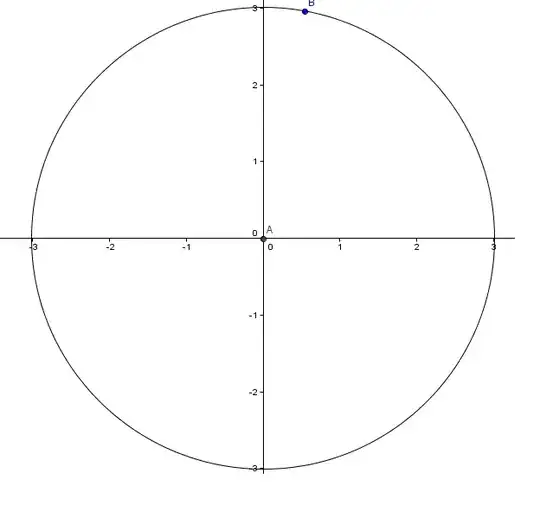
I want to calculate the area of the circle of radius $\mathfrak{R}$. I would like to do it using the Cartesian coordinates (not the polar ones). The problem is that I found the area of a circle of center (0, 0) and radius $\mathfrak{R}$ is $2\pi\mathfrak{R}^2$ which is wrong. So here is my works:

The area of the circle given in the picture is $\mathfrak{A}=4\cdot\mathfrak{a}$ where $\mathfrak{a}$ represents the area of one of the quarter (I will calculate the upper right quarter).

Hence, $$\mathfrak{A}=4\cdot\mathfrak{a}=4\cdot \int_{0}^{\mathfrak{R}}\sqrt{\mathfrak{R}^2-x^2}dx=4\cdot\mathfrak{R}^2 \int_{0}^{1}\sqrt{1-t^2}dt=4\cdot\mathfrak{R}^2 \left[\arcsin(t)\right]_{0}^{1}=4\cdot\mathfrak{R}^2 \left[\arcsin(1)-\arcsin(0)\right]_{0}^{1}=4\cdot\mathfrak{R}^2 \dfrac{\pi}{2}=2\pi\mathfrak{R}^2.$$

What is wrong here?

Thanks.

3 Answers3

3

The integral of $\sqrt{1-t^2}$ is $$\frac{t\sqrt{1-t^2}+\arcsin{t}}{2}$$

You can verify this by taking a derivative (the derivative of $\arcsin t$ is $\displaystyle\frac 1{\sqrt{1-t^2}}$), and you can reach this conclusion using integration by parts, where you write $u^\prime = 1$ and $v = \sqrt{1-t^2}$, so $u = t$ and $v^\prime = -\frac t{\sqrt{1-t^2}}$...

Therefore the area is

$$4 R^2 \int_0^1 \sqrt{1 - t^2}\,dx = 2R^2 [t\sqrt{1-t^2} + \arcsin t]_0^1 = \pi R^2$$

1

Ok, from now on, I'm going to use $r$ as the radius.

Area, $A=4\int\limits_{0}^{r}\color{green}{\sqrt{r^2-x^2}}\color{red}{dx}$.

Now, let $x=r\sin(\theta) \implies \frac{dx}{d\theta}=r\cos(\theta)\iff \color{red}{dx=r\cos(\theta)d\theta}$.

Then $A=4\int\limits_{0}^{\pi/2}\color{green}{\sqrt{r^2-r^2\sin^2(\theta)}}\color{red}{r\cos(\theta) d \theta}=4\int\limits_{0}^{\pi/2} \color{green}{\sqrt{r^2(1-\sin^2(\theta)}}\color{red}{r\cos(\theta)d\theta}$

$A=4\underbrace{r^2}_{\text{constant}}\int\limits_{0}^{\pi/2}\sqrt{\cos^2(\theta)}\cos(\theta)d\theta=4r^2\int\limits_{0}^{\pi/2}\cos^2(\theta)d\theta=4r^2\int\limits_{0}^{\pi/2}\frac{1}{2}[1+\cos(2\theta)]d\theta=2r^2[\theta+\frac{1}{2}\sin(2\theta)]_0^{\pi/2}=4=2r^2[(\pi/2+0)-(0+0)]=\frac{2\pi r^2}{2}=\boxed{\pi r^2}$.

PS: I should probably justify changing my limits. Well, here it is:

$x=r\sin(\theta)\implies\theta=\arcsin(\frac{x}{r})=\begin{cases} \arcsin(1)=\pi/2 &\mbox{if } x=r \\ \arcsin(0)=0 \ &\mbox{if } x=0 \end{cases} \\$

beep-boop
  • 11,595
0

This is equivalent to integrating:

$$\int_{-r}^{r}\; \int_{-\sqrt{r^2-x^2}}^{\sqrt{r^2-x^2}}\; 1\; dy\; dx = 2 \int_{-r}^{r}\; \sqrt{r^2-x^2}\; dx \\ = r\cdot [2 \int_{-r}^{r}\; \sqrt{1-(x/r)^2}\; dx] \\ = r\cdot [2 \int_{-1}^{1}\; \sqrt{1-u^2}\; (r\; du)] \\ = r^2\cdot (2\int_{-1}^{1}\; \sqrt{1-u^2} du) = \pi\cdot r^2 $$ by definition of $\pi$.

If this is not how you defined $\pi$, then choose $u = \sin(t)$ and you are integrating $\cos^2(t)$ from $-\pi/2$ to $\pi/2$, which by symmetry with $\sin^2$ and the identity $\cos^2 + \sin^2 = 1$ is $\pi/2$. Take the factor of $2$ into account and we are done.