1

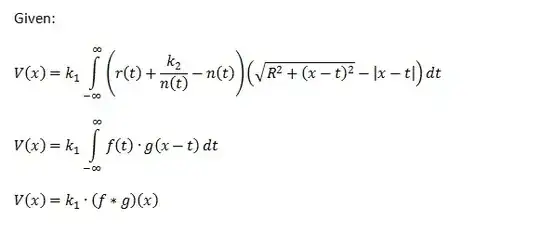
I need to find the derivative of the following equation, which I do think is a convolution:
enter image description here

Could anybody give me a hint on how to find the derivative of V(x)?

Many thanks in advance!

  • 3
    The derivative of a convolution is a convolution of one function with the derivative of the other, i.e. $y=xf\Rightarrow y'=x'f=x*f'$. So you need to apply this and chain rule. – yoki May 29 '14 at 12:04
  • I assume that you need to take the derivative with respect to x? If so, you pretty much have to integrate, then differentiate, since the integral is not from a constant to "x" (therefore the Fundamental Theorem of Calculus does not apply). – FundThmCalculus May 29 '14 at 12:05
  • @ido I think it would be clearer if you had written $y = fg \Rightarrow y' = f'g = f*g'$. In the OPs notation, $x$ denotes the variable with respect to which he differentiates. – Stephen Montgomery-Smith May 29 '14 at 12:42
  • @Torro How did you leap from $V(x)=k_1 \int_{-\infty}^{\infty} f(t)\cdot g(x-t);\mathrm{d}t$ to $V(x) = k_1(f\cdot g)(t)$? – Graham Kemp May 29 '14 at 13:13
  • 1
    @GrahamKemp that's the definition of a convolution: $$ f * g (x) \equiv \int_E f(t) g(x - t) , \mathrm{d} t $$ – DanZimm May 30 '14 at 21:55
  • @Danzimm The original image had $(f\star g)(\mathbf{t})$. That's been corrected. – Graham Kemp May 31 '14 at 00:36
  • @GrahamKemp ah ok cool, sorry for the issue! – DanZimm May 31 '14 at 00:44

2 Answers2

0

Generally, let $\exists F(x,t): F_t(x,t)=\dfrac{\partial F(x,t)}{\partial t}, F_x(x,t)=\dfrac{\partial F(x,t)}{\partial x}, F_{x,t}(x,t)=\dfrac{\partial^2 F(x,t)}{\partial x\;\partial t}$

Specifically: $F_t(x,t)=f(t)\cdot g(x-t)$

$$\displaystyle \begin{align}\because \frac{\mathrm{d}}{\mathrm{d} x}\int_a^b F_{t}(x,t) \;\mathrm{d}t & = \frac{\mathrm{d}}{\mathrm{d} x}(F(x,b)-F(x,a)) \\ & = F_x(x,b)-F_x(x,a) \\ & = \int_a^b F_{x,t}(x,t)\;\mathrm{d} t \\ & =\int_a^b \frac{\partial}{\partial x} F_t(x,t)\;\mathrm{d} t \\ \therefore \frac{\mathrm{d}}{\mathrm{d} x} \int_{-\infty}^{\infty} f(t)\cdot g(x-t)\;\mathrm{d} t & = \int_{-\infty}^{\infty} f(t)\cdot \frac{\partial\; g(x-t)}{\partial x} \;\mathrm{d} t \end{align}$$

Graham Kemp
  • 129,094
0

Many thanks for your replies.

Two questions:

  1. Can I still apply Graham's derivation although dg(x-t)/dx in my case is NOT continous?

  2. According to the other comments above, the following should also be allowed (in addition to Graham's derivation):
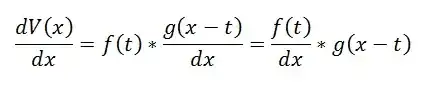
I can't really see that 2.) makes sense, since f(t) in a convolusion by definition never is a function of x and its derivative to x would always give 0. Could somebody maybe comment on this?!

  • Just watch the point of discontinuity. $\displaystyle \frac{\partial;g(x-t)}{\partial;x}=\frac{x-t}{\sqrt{R^2+(x-t)^2}} + \frac{|x-t|}{x-t} , \forall x\neq t$ – Graham Kemp May 31 '14 at 00:50
  • Let $h(z) = \dfrac{z}{\sqrt{R^2+z^2}} + \operatorname{sign}(z)$ then $\displaystyle\dfrac{\mathrm{d} V(x)}{\mathrm{d}x} = k_1\int_{\mathscr{E}} f(t)\cdot h(x-t);\mathrm{d} t = k_1 (f\star h)(x)$
  • – Graham Kemp May 31 '14 at 00:59
  • Dear Graham, I am sorry, but I can not see the point of your answers. Could you maybe add some verbal explanation? Many thanks for your help. – Sweetheart Jun 02 '14 at 09:01