Let $p$ and $q$ be positive real numbers such that $p+q = 1$. am interested in in the large-$n$ behaviour of a following sum: \begin{equation} \sum\limits_{j=0}^{n-1} \left(1 + \frac{n-j-1/2}{j+1} \frac{q}{p}\right) C^{n-1}_j C^n_j q^j \end{equation} I suspect that the sum behaves like: \begin{equation} {\mathfrak A}_p ({\mathfrak B}_p)^n \end{equation} as $n \rightarrow \infty$.
Below I enclose two figures. The one on the left shows the sum as a function of n for different values of $q=0,3,0.4,\cdots,0.9$ (in Red, Orange,Magenta,..,Green and Blue respectively). The one on the right shows a logarithmic derivative of that sum .
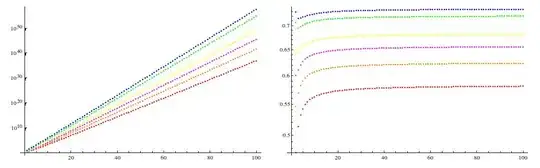
As we can see the sum clearly behaves exponentialy for big values of $n$. How do I find the closed form solution that describes that behaviour?

\binom{n}{j}. – Daniel Fischer Jul 25 '14 at 17:40