3

Question:

(23) If $z_1$, $z_2$ are complex numbers such that $\left|\dfrac{z_1-3z_2}{3-z_1\overline{z}_2}\right|=1$ and $|z_2|\neq 1$, then find $|z_1|$.

How would I attempt this question? I tried using values for $z_1$ and $\overline{z}_2$ but it is coming out to be extremely lengthy. There is probably a quicker solution to this. Can someone provide me with a hint to start?

Gummy bears
  • 3,408
  • $\frac{a}{b} = 1$ can be written as $a = b$. Since both are absolute values, it is easier to deal with the squares, so look at $a^2 = b^2$, viz. $\lvert z_1 - 3z_2\rvert^2 = \lvert 3-z_1\overline{z_2}\rvert^2$. – Daniel Fischer Jul 28 '14 at 12:45
  • http://en.wikipedia.org/wiki/Blaschke_product – Jack D'Aurizio Jul 28 '14 at 13:01
  • @DanielFischer Will the answer come out to be 3?? – Gummy bears Jul 28 '14 at 13:25
  • It should. If not, you have a mistake. – Daniel Fischer Jul 28 '14 at 13:27
  • @DanielFischer I got the answer to be 3. Just checking if it is right. Thanks. But I don't think I did the correct procedure. I squared on both sides, and then just distributed the square evenly as if the terms were in multiplication. Can you show me the correct way to do it? (I just noticed the fact when I was reviewing my answer.) – Gummy bears Jul 28 '14 at 13:33
  • Knowing a little bit about the geometry of linear fractional transformations can get you the answer. See my answer below. – Michael Hardy Jul 28 '14 at 14:10

4 Answers4

2

When dealing with absolute values, it is usually more convenient to look at the squares, since we have $\lvert a+b\rvert^2 = \lvert a\rvert^2 + a\overline{b} + \overline{a}b + \lvert b\rvert^2$ as a convenient expansion. Here, we compute

$$\begin{align} \lvert 3 - z_1\overline{z_2}\rvert^2 - \lvert z_1 - 3z_2\rvert^2 &= (9 - 3 z_1\overline{z_2} - 3\overline{z_1}z_2 + \lvert z_1\overline{z_2}\rvert^2) - (\lvert z_1\rvert^2 - 3z_1\overline{z_2} - 3\overline{z_1}z_2 + 9\lvert z_2\rvert^2)\\ &= 9 + \lvert z_1\rvert^2\lvert z_2\rvert^2 - \lvert z_1\rvert^2 - 9\lvert z_2\rvert^2\\ &= (9 - \lvert z_1\rvert^2)(1-\lvert z_2\rvert^2), \end{align}$$

and find that

$$\left\lvert \frac{z_1-3z_2}{3 - z_1\overline{z_2}}\right\rvert = 1 \iff \bigl( \lvert z_2\rvert = 1 \lor \lvert z_1\rvert = 3\bigr).$$

More, we can read off exactly when $\frac{z_1-3z_2}{3-z_1\overline{z_2}}$ is in the interior or in the exterior of the unit disk.

Daniel Fischer
  • 206,697
  • Wait.... Why is there mod inside the parentheses? It doesn't make sense? And also we are given that $z_2$ is not equal to 1. – Gummy bears Jul 28 '14 at 13:47
  • If the condition is $\lvert z_2\rvert = 1 \lor \lvert z_1\rvert = 3$, and we are given that $\lvert z_2\rvert \neq 1$, then we can conclude that $\lvert z_1\rvert = 3$, can't we? I don't understand your objection to the absolute values in the parentheses. We are computing with (the squares of) absolute values, so of course there will be (squares of) absolute values. – Daniel Fischer Jul 28 '14 at 13:53
  • But you can't distribute mod over addition? The expansion that you have provided, is that simply a rule or can it be derived? – Gummy bears Jul 28 '14 at 13:55
  • We have $\lvert a+b\rvert^2 = (a+b)(\overline{a+b}) = (a+b)(\overline{a} + \overline{b})$. Now multiply out, and use that $\lvert a\rvert^2 = a\overline{a}$ and similarly for $b$ to get the first formula. Apply that with $a = 3$ and $b = - z_1\overline{z_2}$ for the first and $a = z_1,, b = -3z_2$ for the second summand. – Daniel Fischer Jul 28 '14 at 14:00
  • There. Now I understand. That makes it much easier. Thanks a lot. So this is the best way to deal with questions that have modulus on both sides? – Gummy bears Jul 28 '14 at 14:02
  • Often. There are always exceptions, but as a rule of thumb, when you have a modulus of a sum/difference, squaring it will usually make it easier to deal with. – Daniel Fischer Jul 28 '14 at 14:06
2

$$\left|\frac{z_1-3z_2}{3-z_1\overline{z_2}}\right|=1 \Rightarrow \left|z_1-3z_2\right|=\left|3-z_1\overline{z_2}\right| \Rightarrow \left|z_1-3z_2\right|^2=\left|3-z_1\overline{z_2}\right|^2 \Rightarrow (z_1-3z_2)(\overline{z_1-3z_2})=(3-z_1\overline{z_2})(\overline{3-z_1\overline{z_2}}) \\ \Rightarrow (z_1-3z_2)(\overline{z_1}-3\overline{z_2})=(3-z_1\overline{z_2})(3-\overline{z_1}z_2) \\ \Rightarrow |z_1|^2-3z_1\overline{z_2}-3\overline{z_1}z_2+9|z_2|^2=9-3\overline{z_1}z_2-3z_1\overline{z_2}+|z_1|^2|z_2|^2 \\ \Rightarrow |z_1|^2+9|z_2|^2-|z_1|^2|z_2|^2-9=0 \\ \Rightarrow (|z_1|^2-|z_1|^2|z_2|^2)-(9-9|z_2|^2)=0 \\ \Rightarrow |z_1|^2(1-|z_2|^2)-9(1-|z_2|^2)=0 \\ \Rightarrow (|z_1|^2-9)(1-|z_2|^2)=0 \\ \Rightarrow |z_1|^2-9=0 \text{ or } 1-|z_2|^2=0 \Rightarrow |z_1|=3 \text{ or } |z_2|=1$$ Since $|z_2|=1$ we get $|z_1|=3$

Mary Star
  • 13,956
1

$$ \left|\dfrac{z_1-3z_2}{3-z_1\overline{z}_2}\right|=1 $$ Let $$ w=\dfrac{z_1-3z_2}{3-z_1\overline{z}_2}. $$ Then \begin{align} w(3-z_1\bar{z}_2) & =z_1-3z_2 \\[8pt] 3w-w z_1\bar{z}_2 & = z_1 - 3z_2 \\[8pt] 3w+3z_2 & = z_1+wz_1\bar{z}_2 \\[8pt] 3w+3z_2 & = z_1(1+w\bar{z}_2) \\[8pt] 3\frac{w+z_2}{1+w\bar{z}_2} & = z_1 \tag 1 \end{align} Finding the two fixed points of $w\mapsto \dfrac{w+z_2}{1+w\bar{z}_2}$ is solving a quadratic equation, and the solutions are $\pm z_2/\bar{z}_2$, and these are antipodal points on the unit circle centered at $0$. Now observe that the point $iz_2/\bar{z}_2$, which is on the unit circle, is mapped by this linear fraction transformation to $$ \frac{iz_2}{\bar{z}_2}\cdot\frac{1+\bar{z}_2}{1+z_2}, $$ which is also on th unit circle. Since linear fractional transformations map every circle to a line or a circle, we conclude that the unit circle centered at $0$ is invariant under this l.f.t. Consequently the number in $(1)$ has norm $3$.

1

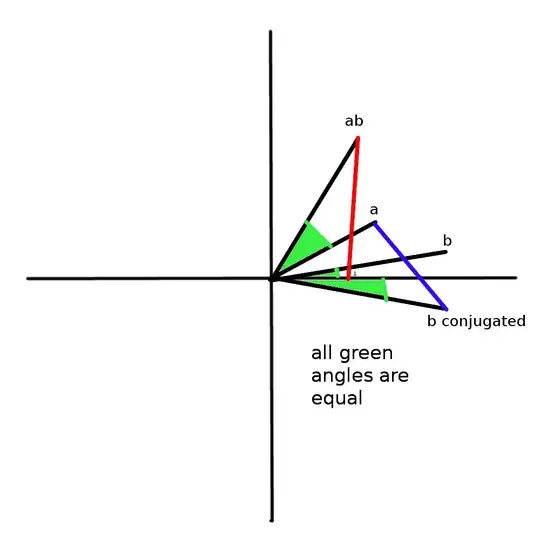
enter image description here$$\frac{z_1 - 3z_2}{3 - z_1 \overline{z_2}} = \frac{\frac{z1}{3} - z_2}{1 - \frac{z1}{3} \overline{z_2}}$$ $b = \overline{z_1} / 3, a = z_2 \Rightarrow |a - \overline{b}| = |1 - ab|$ and we should find $b$.

Let's look this problem geometrically and consider complex numbers $a, b$ as two-dimensional vectors (common approach). Main idea is that ($Q \angle W$ denotes angle between $Q$ and $W$) $$a \angle \overline{b} = 1 \angle ab$$ Explanation: Let $\arg(a) = \alpha, \arg(b) = \beta$. Then $\arg(ab) = \alpha + \beta, \arg(1) = 0, \arg(\bar{b}) = -\beta$. Hence $a \angle \overline{b} = \alpha + \beta = 1 \angle ab$.

Let $A = |a|, B = |b|$. Having angles equation, we use law of cosines for corresponding triangles and get (|ab| = AB, |1| = 1)

$$(AB) ^ 2 + 1^2 - 2 AB \cos(\alpha + \beta) = A^2 + B^2 - 2 AB \cos (\alpha + \beta)$$ $$A^2 B^2 + 1 = A^2 + B^2$$ $$B^2 (A^2 - 1) = A^2 - 1$$ Given $1 \neq |z_2| = |a| = |A|$, $$B^2 = 1$$

Therefore, $B = 1$ because it is be positive. But $1 = B = |\overline{z_1} / 3| = |z_1| / 3$, so answer is 3.

  • Cosine theorem as in the cosine law? That we use for finding the angle in a triangle when three sides are given? – Gummy bears Jul 28 '14 at 14:44
  • And also we are given that $z_2$ is not equal to 1. So how would we get the answer as 3? – Gummy bears Jul 28 '14 at 14:47
  • @Gummybears
    1. Fixed.
    2. We got $B = 1$, but $B = |b| = |z_1 / 3|$, so $|z_1| = 3$.

    Strange, but I get that $|z_2|$ is always equal to 1. I can not find flaw in my solution. Maybe this condition should be discarded.

    – Richard Wagner Jul 28 '14 at 14:56
  • Question. Why is it $$1∠ab$$ (b means b conjugate, not sure how to do the line on top thingy) Why isn't it just between 1 and $ab$?? – Gummy bears Jul 28 '14 at 15:00
  • Argghhhh. Method is really difficult to understand :/ Very difficult to picture the triangles. I'm pretty sure this is the quickest method to get me the answer though. I would really like to learn the method. – Gummy bears Jul 28 '14 at 15:05
  • 1
    @Gummybears I made some minor misprints at the beginning. Fixed. B conjugated is in the condition. – Richard Wagner Jul 28 '14 at 15:05
  • 1
    @Gummybears I will try to make a picture. – Richard Wagner Jul 28 '14 at 15:07
  • Another question. Sorry, this must be getting frustrating for you. If it is b conjugate, shouldn't it be $1 + A^2B^2−2AB\cos(α-β)$ as the argument of b conjugate is $-\beta$?? – Gummy bears Jul 28 '14 at 15:09
  • @Gummybears I've made a picture. Answer to the last question: I found more minor misprints, but now it is OK. Try to read it all anew looking at picture and you will understand it, I hope. It is quite easy. – Richard Wagner Jul 28 '14 at 15:56