I have a question as follows:
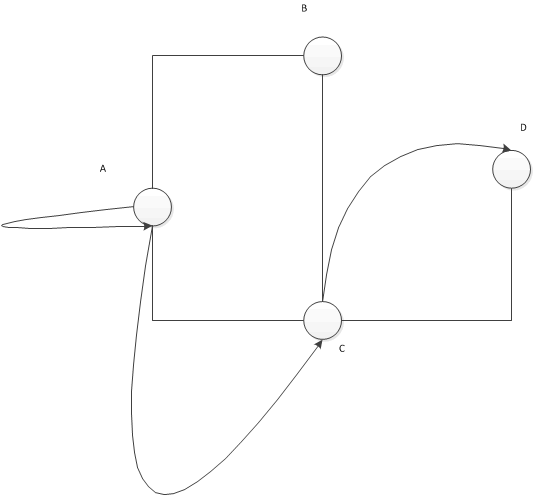
The stylised map below shows the bus routes in a holiday area. Lines represent equivalent routes that run each way between the resorts. Arrows indicate one-way scenic routes.
map here: map
To avoid drawing the map I will just say that there are four towns on the map which we can label A through D and the following matrix describes the routes:
         A   B   C   D
From  A  1   1   2   0
      B  1   0   1   0
M =   C  1   1   0   2
      D  0   0   1   0
So in case of A to A there is a one way scenic route so we put 1 in A to A matrix above. The other towns do not have a route from eg Beesborough to Beesborough so we put a zero in the eg B to B matrix position.
I hope this makes sense.
Now the part of the question I just don't get is where it says calculate M^2 and explain what information it contains.
Well, I can calculate M^2 ok. But I had no idea what practically it represents. In the book answer, it says M^2 represents the number of two stage routes between each pair of resorts. But how do you make the mental leap from M^2 to number of two stage routes? How does this work?
M^2 is:
         A   B   C   D
From  A  4   3   3   4
      B  2   2   2   2
M =   C  2   1   5   0
      D  1   1   0   2