14

There are different categories of numbers that we use every day.

  1. Integers that written in decimal notation have $1, 2$ or $5$ as the leading figure, followed by none, one or more zeros. These are very common numbers, e.g. used in Bank notes: $1, 2, 5, 10, 50, 200, 1000, ....$

  2. Other intergers, which are less common, e.g. your (approximated) height in $cm$, the (approximate) temperature of your body or the environment, or the (approximate) result of converting $200$ miles to kilometers.

  3. Numbers that are not integers, such as $\$1.23$.

If you have $\$198$ (category $2$) bill in a restaurant, you'd probably tip $\$2$ to round it to $\$200$ (category $1$).

Is there a term for numbers of category $1$?

Roby5
  • 4,287
  • 16
    "Round"? That's what I hear in non-math conversation anyway... – Alex Becker Dec 23 '11 at 09:24
  • 1
    I edited the question to fix a formatting issue. You need to escape dollar signs with a backslash in order to get the symbol $ to display. As a side note, I'm not sure this is an appropriate question for Math.SE, as it isn't really a "math question" in my book. – Alex Becker Dec 23 '11 at 09:27
  • 8
    Not a real question. – The Chaz 2.0 Dec 23 '11 at 09:42
  • 200 miles is exactly 321.8688 kilometres – Henry Dec 23 '11 at 09:57
  • 8
    I think this is a perfectly good question, with good answers by Zev and Henry. – Chris Taylor Dec 23 '11 at 11:07
  • I don't mind risking some flag weight on a question like this. And thanks to the moderator attention (and answer!), I learned something :) – The Chaz 2.0 Dec 23 '11 at 11:58
  • 4
    You would only tip 2 on a 198 tab? I would hate to be your waiter! – JD Isaacks Dec 23 '11 at 14:08
  • 13
    FYI: in the USA a tip of $2 on a $198 bill is more offensive to a waiter than spitting at them. The appropriate tip for good service for a $198 bill is about $36. Waiters make MUCH less than minimum wage (without tips). In fact, when I was a waiter the taxes on my tips were sometimes greater than my hourly wages; I had to actually pay the restaurant to get my $0.00 check (seriously). ProTip: Cash tips are usually preferred to tips with credit - for uh, reasons the government frowns upon. – David Murdoch Dec 23 '11 at 15:08
  • 2
    @David: And elsewhere tips are different. It's useless to discuss tips without specifying the cultural situation, so let's not get into that on a question not related to the subject. – Joren Dec 23 '11 at 16:49
  • 2
    @Joren, Uh, I specified the cultural situation of my comment when I said "in the USA". And I was more-or-less clarifying John Isaacks' comment directly above mine, which assumes the OP's culture subscribes to a higher rate for tips. – David Murdoch Dec 23 '11 at 17:17
  • 2
    @DavidMurdoch In our culture, we dont tip! So my assumption could be wrong. – Shiplu Mokaddim Dec 23 '11 at 17:19
  • 3
    Hey guys, sorry to have stirred a turd, I usually forget to consider that things are different in other cultures. I only posted the comment to be humorous, I didn't even consider it being a real tip, just an example to clarify his question. – JD Isaacks Dec 23 '11 at 18:08
  • 2
    There are two types of questions. No wait. There are THREE types of questions: 1) good. 2) bad. 3) edited so much that eventually they become good – The Chaz 2.0 Dec 23 '11 at 18:41
  • @David: I was talking about the OP there – Joren Dec 24 '11 at 23:10
  • 1
    @DavidMurdoch: from a non-US (French) perspective, the ones that are spitting in the face of waiters are the ones that are paying them less than the minimum (sic) wage! – Taladris May 06 '16 at 10:37

5 Answers5

26

The first category is known as the 1-2-5 series, and it is an example of a system of preferred numbers. As the name implies, there is nothing mathematically distinctive about such numbers; humans just prefer them.

Zev Chonoles
  • 129,973
  • Thanks for the name and the wiki link. I was just looking for this – Shiplu Mokaddim Dec 23 '11 at 11:02
  • 1
    +1 for "I can't believe there's a name for this." But is there really nothing mathematically distinctive about the 1-2-5 series relative to base 10? (Obviously base 10 is an arbitrary preference.) – Jesse Madnick Jun 20 '12 at 21:17
14

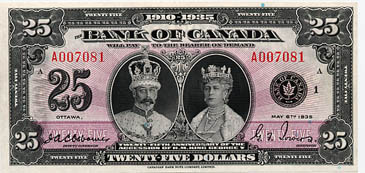
The OEIS calls your first set a "Hyperinflation sequence for banknotes", though there have been many coins and banknotes with different denominations around the world, such as a $1935$ Canadian $\$25$ note.

Mathematically they are the numbers generated by $$\frac{1+2 x+5 x^2}{1-10 x^3}.$$

People have counted with other patterns, notably the Babylonian sexagesimal system which we still use for minutes and seconds and so often think of $15$ and $30$ as round in some contexts.

Roby5
  • 4,287
Henry
  • 157,058
  • I don't have time to work through it, but I wondered: If you took the sequence generated by $(1+mx+nx^2)/(1-bx^3)$, would it generate the $(1,m,n)$ sequence in base $b$? Probably not, I guess. Does it work if $b=mn$? – Chris Taylor Dec 23 '11 at 16:50
  • @Chris: That should work as $1/(1-bx^3) = 1 + bx^3+ b^2 x^6 + \ldots$ – Henry Dec 23 '11 at 16:53
  • @Henry Could you tell me what is the range of x? I wrote a program to generate those numbers. But I see all are negative and floating point. It was actually obvious as $-x^3$ in the equation – Shiplu Mokaddim Dec 23 '11 at 17:24
  • 1
    @Shiplu: this is an ordinary generating function producing $1+2x+5x^2+10x^3+20x^4+50x^5+100x^6+\cdots$, converging when $|x^3|<0.1$. To find the coefficient of $x^n$, you might take the $n$th derivative at $x=0$ and then multiply by $n!$. – Henry Dec 23 '11 at 17:49
  • Using the expression given in this answer, f(x = 1) = -0.888... and likewise integer x does not give anything close to the 1-2-5 series. What's this equation for? – kapple Dec 12 '21 at 20:16
  • 1
    @kapple This is not an equation but a generating function. My comment to Shiplu immediately before yours explains this and provides a link. – Henry Dec 13 '21 at 01:15
4

I believe the most easily understood term for them is numbers with one significant figure.

Preemptive argument against pedantic people:

While it is true that "with one significant figure" can be used to describe a value and does not serve the asker's purpose in that case, it can also be used to refer to number and when it does, it does serve the asker's purpose. How clear one must be to ensure that everyone knows you are referring to numbers, not values, depends on the context the phrase is used in.

Secondly, one might say you need to specify the number system when speaking of significant figures, however, if you don't, in most contexts it can be assumed you are talking about decimal numbers.

Joe
  • 191
  • Although it's not clear from the title of the question, it is stated in item 1 of the question that the OP wants those numbers that have 1, 2, or 5 as the unique significant digit. Thus, for example, 300 has only one significant figure, but belongs to class 2, not 1, in the OP's classification. – Andreas Blass Aug 28 '13 at 17:16
1

When I looked at these numbers, the first thing that occurred to me was "These are numbers that divide a power of the base (10, in this case)." Looking again, this description is more general than your case 1 (because it includes values such as 25), but seems to me to capture much of the idea of a number being "round".

Anyway, that's my 50 cents worth.

marty cohen
  • 107,799
0

In regards to whatr marty wrote:

It is not that these numbers can be divided a power of the base 10. (well yes, but that is hot their definition)

The definition should be:

Ten to the power of (n-1), where n is the numbers of digits of the numbers divides the numbers in categorie 1.

Prankster
  • 567
  • 4
  • 15