5

I'm reading the following article, but there was one line where I wasn't quite sure if it was allowed or not.
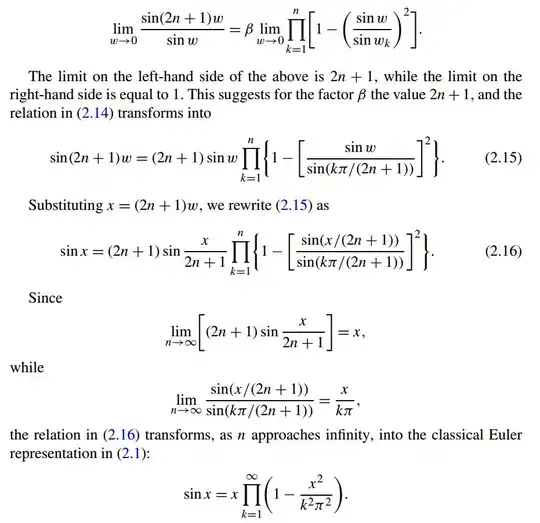
enter image description here

It's where they took the limit as $n\rightarrow \infty$

Now, they got $\lim_{n\rightarrow \infty} \left [ (2n+1)\sin \frac{x}{2n+1} \right ]=x$

I have some issue with this because $x$ and $n$ are related by $x=(2n+1)w$, so wouldn't making $n\rightarrow \infty$ also affect $x$?

Can we simply 'pause the $x$' and then take the limit in terms of $n$ purely, as they did?

Trogdor
  • 10,331

1 Answers1

0

In fact, it is a good question, but to me it seems that some thing different happens in this case. See for example : take $\lim_{w\to 0}\frac{\sin w}{w}=1$ if we change, $w=\frac{x}{2n+1}$than $\lim_{x\to 0}\frac{\sin \frac{x}{2n+1}}{\frac{x}{2n+1}}=1$ because you are changing the variable $w$ and it implies that the variable $x$ also changes. But it is different of taking $\lim_{n\to \infty}(2n+1)\sin \frac{x}{2n+1}$ since your $x$ is not affected, because when you take the relation $w=\frac{x}{2n+1}$ your $w$ goes to $0$ as $n\to \infty$, but this realation nothing says about $x$, it stays the same. Do you see?

math_man
  • 1,574