5

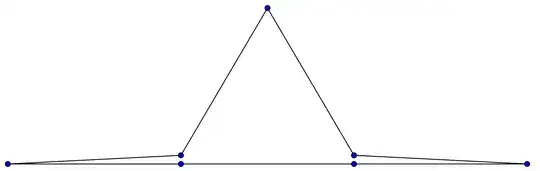
Given an odd number $n$, consider all non-self-intersecting polygons with $n$ sides, all of length $1$. What is the infimum of their areas? We can approach $\sqrt 3/4$ by approximating an equilateral triangle of side $1$, like this:

enter image description here

Can we do better?

hardmath
  • 37,015
TonyK
  • 64,559
  • The example you show has seven sides. Should we take a generic odd $n$ to be the natural generalization of that? (With $4n$ edges making up the wings rather than than $4$ as above). – Semiclassical Sep 18 '14 at 19:07
  • @Semiclassical: Yes, if by $4n$ you mean $n-3$. – TonyK Sep 18 '14 at 19:07
  • Woops, I meant that the number of edges in the wings is a multiple of 4. – Semiclassical Sep 18 '14 at 19:16
  • @Semiclassical: It won't be a multiple of $4$ unless $n \equiv 3$ mod $4$. – TonyK Sep 18 '14 at 19:37
  • If the wings could be of unequal length, we could extend this example to any odd n. Actually, do we even really need two wings--would it be sufficient to have a wing only on one side? – David K Sep 18 '14 at 19:37
  • @DavidK: Yes, of course it would be sufficient. The question is, can we do better than $\sqrt 3/4$? – TonyK Sep 18 '14 at 19:38
  • 1
    This is an interesting problem. Does it have a history,where does it come from? I feel this should be one of the many famous open problems in geometry,e.g. of the rank of the inscribed squares problem,but I couldn't find much about this one. I tinkered a little bit with 7 vertices and 5 vertices polygons,and because all sides are length 1, one could clearly see that one cannot pinch two vertices close to each other,without making a bunch of other vertices also to move along.(I used Cinderella Geometry,I would think GeoGebra would work too).Curious https://en.wikipedia.org/wiki/Shoelace_formula – Mirko Mar 29 '21 at 23:02
  • Wikipedia has also a couple of other formulas for the area of a polygon https://en.wikipedia.org/wiki/Polygon#Area In particular (Lopshits 1963) gives a formula in terms of lengths of sides and $\sin$ of exterior angles and sums thereof (and it of course simplifies when each side has length 1). Or one could put the polygon in general position and try find area using integral ... not that I know how that would work, but I feel that the approach (in posted answers) of gradually changing the shape of the polygon runs into difficult details, and one wishes to use some "direct" single step approach – Mirko Mar 29 '21 at 23:39
  • Thank you for your comments, @Mirko! The problem, as far as I know, is my own; it occurred to me one day while I was doodling. Of the two formulas you link to, the Lopshits formula looks the more promising to me, but I don't yet see any way of applying it. – TonyK Mar 30 '21 at 10:00
  • Thanks for the quick response on my (now deleted) mistaken answer. I looked at the situation for $3$ minutes, before responding. Blind spot, about $29 \times 31$. – user2661923 Feb 18 '22 at 19:54
  • 1
    On Researchgate, I found "The minimum area of a simple polygon with given side lengths" Periodica Mathematica Hungarica 39(1):33-49 December 2008 K. Böröczky, G. Kertész, E. Makai, available here – Jean Marie Aug 30 '22 at 05:32
  • Thank you @JeanMarie! That seems to answer my question. – TonyK Aug 30 '22 at 11:03

2 Answers2

1

One cannot do better. I'm coming short of a proof, but following is the skeleton of a proof.

Idea: recursively chop down the polygon into polygons having all unit sides except one side, of length $x \leq 1$ showing that the minimum area of the parts is some function of $x$. It results in a series of small geometric problems.

Definitions

For $0 \leq x \leq 1$, let an “odd-$x$-poly” be a non-self-intersecting polygon with an odd number of sides, where all sides except one have unit length. The other side has length $x$.

For $0 \leq x \leq 1$, let an “even-$x$-poly” be a non-self-intersecting polygon with an even number of sides, where all sides except one have unit length. The other side has length $x$.

Induction

By induction we will construct the proofs for

$O_n$ : The area of an $n$-sided odd-$x$-poly is at least ${x \over 2} \sqrt {1 - {x ^2 \over 4}}$

$E_n$ : The area of an $n$-sided even-$x$-poly is at least ${1 - x \over 2} \sqrt{1 - {{(1-x)^2} \over 4}}$

$O_3$ is proven trivially by considering the formula for the area of the isosceles triangle.

$E_4$ is proven in [...] (figure 2).

Let’s consider an $n$-sided odd-$x$-poly $p$.

There’s three cases:

  1. No vertices or edges from p in the triangle created by ag and two unit sides. Figure 4.

    In this case, this area without vertices is already large enough to satisfy $O_n$.

  2. A vertice is present, say, $d$. Figure 1

    In this case, the area of $p$ is either:

    • the area of a $l$-sided even-$y$-poly ($abcd$) plus the area of another $m$-sided even-$z$-poly ($defg$), where $y+z > x$, plus the area of $adg$. Figure 1. $O_n$ is true by [...] ( Some proof missing using geometry and $E_{i}, i<n$. )

    • the area of a $l$-sided odd-$y$-poly ($abc$) plus the area of another $m$-sided odd-$z$-poly ($cde$), where $y+z > x$, plus the area of $ace$. Figure 3. $O_n$ is true by [...] ( Some proof missing using geometry and $O_{i}, i<n$. )

In both cases, it should be possible to prove $O_n$, from $O_x$ and $E_y$, with $x<n, y<n$.

  1. An edge goes through the triangle created by ag and two unit sides. (Figure 5). Given how $c, d$ must be at distance of at least 1 of $a, b$, a construction showing $O_n$ is possible, given $O_i$ and $O_j$, with $i<n, j<n$.

Let’s consider an $n$-sided even-$x$-poly $p$. Similar construction as above, missing, switching odd and even sub-polygons.

Very interesting problem, but I've used the time I had to put towards it. Sorry for the missing parts.

Finally, once the missing bits in the proof are added, one can observe that the polygon described in the problem is a even-$x$-poly with $x=1$. Thus we find the specified minimal area.

figures

Jeffrey
  • 586
  • This is interesting! I will have to look through it carefully. A question: in Case 3 (figure 5), are you sure that $c$ and $d$ must be distant at least $1$ from $a$ and $b$? (And a small nitpick: you are using $x$ as a side length $\le 1$, and also as an integer subscript in $O_x$. This is rather confusing. I suggest $O_i$ and $E_j$.) – TonyK Jan 26 '15 at 10:53
0

No, one cannot do better.

Consider a polygon $P_0$ with $n$ odd, edges or length 1. We can repeatedly construct $P_l$ with the same number of unit edges, so that $area(P_{l+1}) \leq area (P_l)$. Until $area(P_{n-1 \over 2})$ is $\sqrt(3) \over 4$.

As such, $area(P_0) \geq {\sqrt(3) \over 4}$. The construction follows.

From $P_l$, take 5 consecutive corners, label them 1,2,3,4,5. Observe that by merging (moving arbitrarily close) corners 2 and 4, we create a sliver $(2,3,4)$, we reduce the area covered by $(1,2,4,5)$ and we keep constant the rest of the area. This gives us $P_{l+1}$. Moving forward, we consider 2 and 4 as a single corner, and disregard 5.

enter image description here

By repeating this process, we always end up with an equilateral triangle and a number of slivers of area almost 0. And we know the original polygon had larger area.

Two missings item in this reasonning that we could elaborate on:

  • Showing that overlapping is not an issue. We might need to generalize to a definition of area that counts doubly the overlapping area, so that 2 and 4 can always be "merged". By the end of the process, though, any overlapping is gone. We just need a definition of area that decreases as we simplify the polygon.
  • Showing that merging corners 2 and 4 always reduce the area. It's pretty evident, but I didn't write up the math for it.
Jeffrey
  • 586
  • 2
    You can't always merge vertices 2 and 4, because vertices 1 and 5 might be more than two units apart. I think this destroys your proof. – TonyK Jan 12 '15 at 17:28
  • Yes, correct. There is a missing branch.

    Either $P_l$ is such that there exist 5 consecutive corners where $2$ and $4$ can be merged or $P$ can already be proven to have a large enough area (by having a shape that is roughly a circle). I'll edit my answer if I can formalize it somewhat enough so that "roughly a circle" is clear.

    – Jeffrey Jan 12 '15 at 18:06
  • I had a second attempt at it, other answer provided. Also incomplete. – Jeffrey Jan 15 '15 at 18:41