I want to find 3D equation of a falling droplet that I have considered it as an ellipsoid. I put two cameras, one in xy plane and another in zy plane to capture two projected views of the droplet and then analyze the frames by image processing to find the related equations for each ellipse and finally the equation for ellipsoid using Finding equation of an ellipsoid. I have only two cameras (i.e. two projected views), so I need one more projected view or another equation(s) to be added to my set of equations.
To test the method, I chose a hypothetical ellipsoid (so I know all 6 coefficients of it)
$$3x^2+3y^2+2z^2+2zy+2xz+2xy=1 \ \tag{1}$$
Then extract the corresponding equations of two projected ellipses. So, I have 6 eqs. and 6 unknowns. When I solved this set of eqs, it gave me 3 different answers (two of them are ellipsoids, while I need just one unique ellipsoid equation)
Therefore, in order not to need the 3rd camera, I supposed that my ellipsoid is a spheroid: $$\alpha_1=\alpha_2 \ \tag{2}$$ and add this as my 7th equation:
$$
\begin{cases}
2/3= \beta_1 - \frac{\beta_2\beta_3}{\alpha_1}\\
8/3= \alpha_2 - \frac{\beta_3^2}{\alpha_1}\\
5/3= \alpha_3 - \frac{\beta_2^2}{\alpha_1}\\
5/2= \alpha_1 - \frac{\beta_2^2}{\alpha_3}\\
5/2= \alpha_2 - \frac{\beta_1^2}{\alpha_3}\\
1/2= \beta_3 - \frac{\beta_1\beta_2}{\alpha_3}\\
\alpha_1=\alpha_2
\end{cases} \ \tag{3}
$$
I anticipated that adding another equation compensates the dependency we have for two of those 6 equations. But, surprisingly I understood that even when I add the 7th equ, the equ. set still returns two ellipsoids:
$$3x^2+3y^2+2z^2+2zy+2xz+2xy=1$$
$$2.7x^2+2.7y^2+1.8z^2+1.2zy-1.2xz+0.6xy=1 \ \tag{4}$$
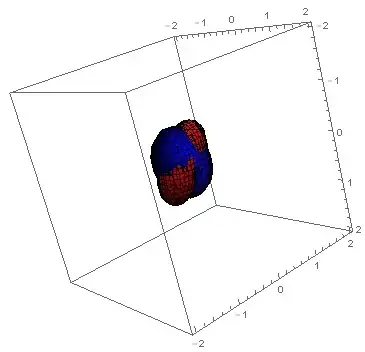
I am enthusiast to know your opinion that for finding a unique ellipsoid by only two projected views, whether it is possible to get any extra required piece of information from somewhere else rather than from adding the 3rd camera. Do you have any idea for doing that?

