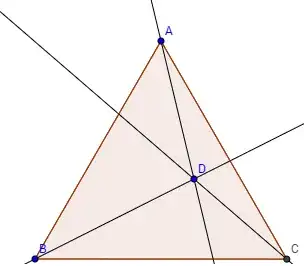
Here my point is $D$ instead of $P$, $s$ is side of triangle:
$|AD|=3,|BD|=4,|CD|=5$
Using cosine rule:
$$\cos \angle ADB=\frac{9+16-s^2}{24}\\
\cos \angle BDC=\frac{16+25-s^2}{40}\\
\cos \angle CDA=\frac{25+9-s^2}{30}\\
$$
Also $\angle ADB+\angle BDC+\angle CDA=2\pi$
So, $cos \angle CDA=\cos (2\pi-(\angle ADB+\angle BDC))=\cos(\angle ADB+\angle BDC)$
$$\begin{align}
cos \angle CDA&=\cos(\angle ADB+\angle BDC)\\
cos \angle CDA&=\cos(\angle ADB)\cos(\angle BDC)-\sin(\angle ADB)\sin(\angle BDC)\\
\end{align}$$
Now we need to solve:
$$\frac{25+9-s^2}{30}=\frac{9+16-s^2}{24}\frac{16+25-s^2}{40}-\sqrt{1-\left(\frac{9+16-s^2}{24}\right)^2}\sqrt{1-\left(\frac{16+25-s^2}{40}\right)^2}
$$
Or:
$$\left(\frac{25+9-s^2}{30}-\frac{9+16-s^2}{24}\frac{16+25-s^2}{40}\right)^2=\left(1-\left(\frac{9+16-s^2}{24}\right)^2\right)\left(1-\left(\frac{16+25-s^2}{40}\right)^2\right)$$
Or:
$$\frac{s^8}{921600}-17\frac{s^6}{230400}+103\frac{s^4}{92160}+119\frac{s^2}{25600}+441\frac1{102400}=\frac{s^8}{921600}-11\frac{s^6}{76800}+47\frac{s^4}{10240}-2017\frac{s^2}{230400}+441\frac1{102400}$$
Or:
$$\frac{s^6}{14400}-\frac{s^4}{288}+\frac{193s^2}{14400}=0$$
As $s\neq0\Longleftrightarrow s^2\neq0$:
$$s^4-50s^2+193=0$$
So:
$$(s^-25)^2=432$$
Which gives:
$$s=\pm_1\sqrt{25\pm_212\sqrt3}$$
Since $s>0$:
$s=\sqrt{25\pm12\sqrt3}\approx 2.0531,6.7664$$


