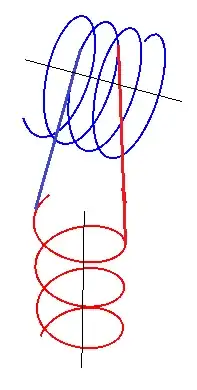
Interesting question describing a direct tangented rubber band between two (different diameter) parallel axis cylinders.. and subsequently twisted to make the axes perpendicular.
At the moment what appears to me as spatial determination/math geometric modeling of the connecting band is the following:
The bands of connecting cylinders run along helical geodesic paths. Else tension in the string veers off the band to slip away making it unstable. When rollers are in rotation and some solid lubricant eg French chalk is applied it becomes intuitively clear what the stable trajectories ought to be.
The taut connecting band in the air lies on a common tangent for edges of regression of tangential developable surfaces ( Gauss curvature $K=0$ ) out of /into either cylinder.
Towards solution of problem:
Parametric equation of Helix 1
$$ (x_1,y_1,z_1)= (a \cos u , a \sin u, p u) $$ where $u$ is reckoned from farthest point on Cylinder 1
Parametric equation of Helix 2
$$ (x_2,y_2,z_2)= (b \cos v +h, b \sin v , q v+k) $$ where $v$ is reckoned from farthest point on Cylinder 2
There are 4 unknowns $ (u,v, p,q)$ , known Cylinder radii $(a,b,h,k)$ including start points offset $(h,k)$.
To solve them the above are two equations.
Next two equations are determined from 3D alignment of direction cosines of common tangent
$$ \frac{x-x_1}{l}=\frac{y-y_1}{m}= \frac{z-z_1}{n} $$
$$\frac{x-x_2}{l} = \frac{y-y_2}{m}=\frac{z-z_2}{n}$$
An alternate modeling way (begin strategy at least) is to minimize total band length on the basis of same four independent variable parameters $(u,v,p,q)$ in
$$ u \sqrt{a^2+p^2} + v \sqrt{b^2+q^2} + \sqrt{(x_2-x_1)^2+(y_2-y_1)^2+ (z_2^2-z_1)^2 }$$
by the usual methods of minimization setting derivatives to zero.
Between centers of helical arcs there is an ascending part and a descending part on either side: