6

For example, from wiki, we know that

$$ \langle i, j \mid i^4 =1, i^2 = j^2, j^{-1}ij = i^{-1} \rangle = Q $$

where $Q$ denotes Quaternion group.

And by my own inspection, I speculated that

$$ \langle i,j \mid i^4 = j^4 = 1, ij = j^3i \rangle =Q $$

though I'm not really sure if it is correct.

I've checked every relation that hold in $Q$ can be derived from the relations in the presentations. But finding the order of the groups generated by the above presentations, I couldn't do it rigorously nor systematically. (I've considered every element that can be formed by the generators in the form $i^a j^b$ with $0 \leq a, b \leq 3$ and relations in the second presentation and for everything I've checked which is equal to which. And for all the elements in that form, to prove which is not equal to which, I've supposed which is equal to which and derived a contradiction. But personally I think my method is just a mess.)

Is there any effective, systematic way for proving this without checking everything?

And please correct me if there is anything wrong.

le4m
  • 3,006
  • 1
    Had you not asked about Q8 (coolest group ever), then I would have mentioned earlier: you don't have to prove that every relation of $Q$ holds in each of the presentations. You only have to show that the 3 relations in the first Q can be derived from the 3 relations in the second, and then vice versa. This is called, van Dyck's lemma, but I don't see a webpage about it. – Jack Schmidt Jun 19 '13 at 23:09
  • (What I mean is: even though (ij)^2 = i^2 in Q, you don't have to prove that it follows from the rules in your presentation. You just have to show i^4=1, i^2= j^2, and j^-1ij = i^-1 follow from i^4=j^4=1 and ij=j^3i, and then vice versa.) – Jack Schmidt Jun 19 '13 at 23:11
  • 2
    @JackSchmidt: I believe it is more commonly known as von Dyck's theorem: http://140.177.205.23/vonDycksTheorem.html –  Jun 19 '13 at 23:31
  • @SteveD: thanks. I checked theorem too, but I think "van Dyck" versus "von Dyck" might also have confused me. – Jack Schmidt Jun 19 '13 at 23:38
  • Wow thanks. I kind of felt that there should be some lemma like that and indeed there is! (It's just that when I was solving the problem in Dummit's, I just didn't know any presentation for $Q$ at all. So I had to do everything from scratch.) – le4m Jun 19 '13 at 23:52

2 Answers2

5

Here is a spooky short presentations of $Q_8$

$$\langle i,j : iji=j, i^2=j^2 \rangle$$

For a finite group, the number of relations is always at least equal to the number of generators, so 2 is the minimum number of relations with two generators. In fact, a group such as $D_8$ cannot have a presentation with only two relations (hard to prove at this stage), because there is a group $G$ ($D_{16}$ in fact) with $G/(Z(G) \cap [G,G]) \cong D_8$. This obstruction to having a short presentation is known as the Schur multiplier.

As far as systematic methods, basically no in general. Standard practical methods for problems of this size are coset enumeration and the Knuth-Bendix algorithm. Sims has a nice book, Computations with Finitely Presented Groups that I found quite enlightening.

If you start with a presentation for a group, you can mix it up using Tietze transformations which can add/remove superfluous generators, and length/shorten relations using other relations. It is fairly similar to Gaussian elimination, except you only get the row ops, you rarely actually know when you have reached the canonical form. In particular, we know there is no algorithm to use Tietze transformations to prove a trivial group is trivial, but we do know at least there is SOME way to use them to prove a trivial group is trivial.

Jack Schmidt
  • 55,589
  • Oh okay. You are mentioning Tietze's also just like the below. It seems I should learn it to solve the above question systematically. – le4m Jun 19 '13 at 22:04
  • I don't personally suggest learning Tietze transformations :-) But yes, you are exactly right. They convert one presentation to another, but given two presentations for the same group, there is no computable bound on how many transformations it takes to get from one to the other. Yucky stuff in my opinion. – Jack Schmidt Jun 19 '13 at 22:06
  • The first presentation you give is called a “polycyclic presentation” and makes it easy to alphabetize the elements like you did, $i^aj^b$. Polycyclic presentations have nice algorithms, but only apply to solvable groups. – Jack Schmidt Jun 19 '13 at 22:08
  • OH nice. Thanks for your knowledgeable answers. And I think your second paragraph actually answers my main question. – le4m Jun 19 '13 at 22:11
3

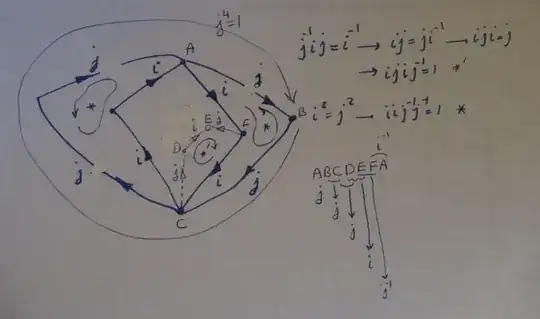
This one is based on using the graphs in presentation of a group, the method called Van Kampen diagram:

enter image description here

You see we can find the presentation of second group as $j^4=1$ the outer circular path and $j^3ij^{-1}i^{-1}=1$ as the closed path $ABCDEFA$.

Mikasa
  • 67,374
  • Can you explain how you made the original diagram? I am guessing something like “I drew the relations from the wiki presentation in the OP, then I followed the paths specified in your second presentation, and they were cycles, so yay.” I read the wikipedia article on van Kampen diagram and still have no clue how to make one or how you made one. :-) – Jack Schmidt Jun 20 '13 at 01:44
  • @JackSchmidt: I made $i\to i\to i\to i$ in the centre, then on the left or right I tried to make something like $*$. If arrow looks like $>$ then it means the for example $i$ or $j$. While circling, if you encounter $>$ then you should consider $i$ or $j$ and if you face to $<$ then we have to consider $i^{-1}$ or $j^{-1}$. Here, when you consider the path from B to F, you should write $ji^{-1}$. I did a similar method for this one before – Mikasa Jun 20 '13 at 05:09