Area of a triangle of sides $ {a, b, c} $ inscribed in a circle of radius $ {R} $ is $ {{{ K}}= {\frac {abc} {4R}}} $
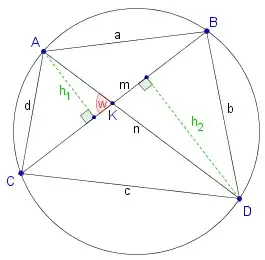
Now, let us consider a quadrilateral with sides ${ AB=p , BC=q , CD=r , DA=s }$.

In Figure 1 :
Divide the quadrilateral into two triangles with area K1 and K2 respectively.Let the area of the quadrilateral be ${Q}$.
Using the formula for Area of Triangle,
$ {K1=\frac {BD.p.s}{4R}} $
${K2=\frac{BD.q.r}{4R}}$
So, ${ Q= K1+K2=\LARGE{{\frac {BD.(ps+qr)} {4R}}}}$ ....(1)
Similarly in Figure 2 :
${K3=\frac {AC.r.s} {4R}}$
${K4=\frac {AC.p.q} {4R}}$
So, ${ Q= K3+K4=\LARGE{{\frac {AC.(rs+pq)} {4R}}}}$ ....(2)
Now, from equation ${(1)}$ & ${(2)}$,
${{AC.(pq+rs)=BD.(ps+qr)}}$
Hence proved,
${\LARGE{{\frac {AC}{BD}} = {\frac {ps + qr}{pq + rs}}}}$



$$\frac{ah_a}{2} = \frac{abc}{4R} \implies 2Rh_a = bc$$
– Stefan4024 Jan 26 '14 at 18:53