What is the limit of $0/x$ as x goes to $0$, without using L'Hopital's rule? Clearly it should be $0$, but I'm not sure how it is any different from something like the divergence of $1/r^2$ which yields a dirac delta.
Asked
Active
Viewed 1,021 times
7
-
2$\dfrac{0}{x}$ is equal to $0$ for all $x\neq 0$. Hence $\lim_{x\rightarrow 0} \dfrac{0}{x} = 0$. – zarathustra Apr 10 '14 at 06:40
-
2There are a few answers here that give the obvious response, but I think more interesting is the fact that OP is somehow thinking that there should be a Dirac delta in this question. – Apr 10 '14 at 06:47
-
1@Mike you are right, didn't notice that the first time. Anonymous, just picture (or use a free online plotting tool) what the two functions you mentioned look like: $0/x$ is just the $x$-axis, minus the point $(0,0)$ where the function isn't defined, whereas $1/r^2$ curves up steeply as $r \to 0$. – user139388 Apr 10 '14 at 06:55
-
@user139388 I think something along that lines would make a good addition to your answer :) – Apr 10 '14 at 07:12
-
What is a Dirac delta? It is certainly not a number (or infinity), and so it can't be the result of taking a limit. – Little Endian Apr 10 '14 at 07:45
3 Answers
3
You don't need L'Hopital's rule. Every term of the sequence $\frac{0}{x_n}$ is $0$ where $x_n \to 0$, so the limit is $0$.
More Detail
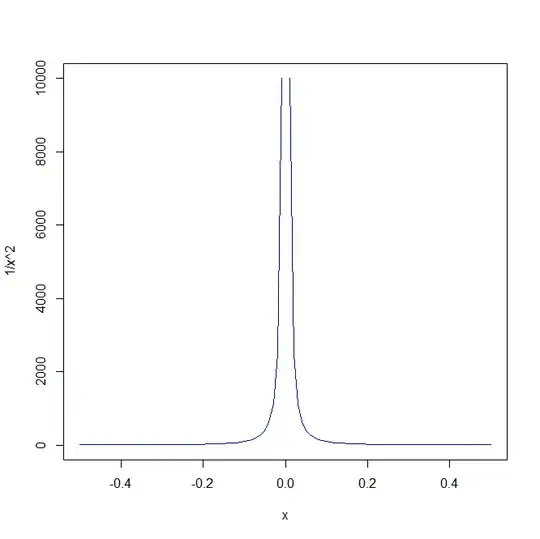
You can picture the two functions you've mentioned: $ f(x) = \frac{0}{x} $ is just the $x$-axis minus the point $(0,0)$ where the function is not defined, whereas $$ g(r) = \frac{1}{r^2} $$ is a function which escapes to $\infty$ quite rapidly as $r \to 0$. Picturing these two functions should help clarify why they have different limits at $0$ (I've included a picture).

user139388
- 3,449
2
Since $\frac0x = 0$ for $x\neq 0$, the limit of $\frac0x$ as $x$ goes to $0$ is the same as the limit of $0$ as $x$ goes to $0$:
$$\lim_{x\to0}\frac0x = \lim_{x\to 0 } 0$$

5xum
- 123,496
- 6
- 128
- 204
1
You could prove it formally by applying the squeeze theorem:
Let I be an interval having the point a as a limit point.
Let g, f, and h be functions defined on I, except possibly at a itself.
Suppose that for every x in I not equal to a, we have $$g(x)\leq f(x)\leq h(x)$$ and also suppose that
$$ \lim _{x\to a}g(x)=\lim _{x\to a}h(x)=L.$$ Then $$\lim_{x \to a}f(x) = L.$$
Setting $a=0$, $f(x)=\frac0x$ and $L=0$, let's use this theorem to prove that $\lim_{x \to 0}\frac0x = 0$:
Let $I$ be an interval around $0$, e.g. $(−1,1)$. I is now an interval having the point a as a limit point. Furthermore, let $g(x)=h(x)=0$, which satisfies $g(x)\leq f(x)\leq h(x)=0$ for all x in I except a (since $f(x)=\frac0x=0$ for all x≠0). Since $ \lim _{x\to a}g(x)=\lim _{x\to a}h(x)=\lim _{x\to 0}0=0$, then $\lim_{x \to 0}\frac0x = 0$. QED.

matthiash
- 183