0

I have a question regarding fundamental groups.

If I take a sphere and union a line between it's poles, is that the same space as the sphere with those poles identified? I am trying to find the fundamental group of the former, and know how to find the fundamental group of the latter, and I also know they have the same fundamental group. Is this the reason why?

I have yet to see a concise solution for the first one on the internet, so I am wondering if this more general statement about lines vs identifications of points is true.

Johnny Apple
  • 4,211
  • What do you mean by "union a line between it's poles"? –  Sep 03 '14 at 03:02
  • union to the sphere a line joining it's north and south poles, inside the sphere. – Johnny Apple Sep 03 '14 at 03:05
  • I'm confused about the "union" part. Perhaps you simply mean a line that joins antipodal points on the sphere. –  Sep 03 '14 at 03:07
  • Sure...is this not also a union? – Johnny Apple Sep 03 '14 at 03:11
  • No, it isn't. It's some sort of cobordism between two antipodal points on the sphere, though. That's why I'm asking for a more precise formulation of the question. –  Sep 03 '14 at 03:22
  • The question views the sphere as embedded in Euclidean space, so I think that's why they state it as a union. – Johnny Apple Sep 03 '14 at 03:36
  • What do you mean by "the same"? Do you mean equal objects? Do you mean equivalent with respect to some specific equivalence relation? – Lee Mosher Sep 03 '14 at 03:54
  • I mean when I compute the fundamental group of one, am I also doing the other one? – Johnny Apple Sep 03 '14 at 03:55
  • It will help to know how much background you have, in order to answer your question well. How much do you know about topology and algebraic topology? How much do you know about the relationship between continuous maps and fundamental groups? – Lee Mosher Sep 03 '14 at 12:21

1 Answers1

1

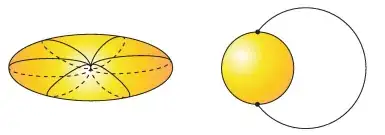
I suspect you are asking about the following picture:

pic

which is (a coloured version of) Figure 7.9 in my book Topology and Groupoids where the relation with a result on mapping cylinders is explained. That result is that if $i: A \to X$ is a closed cofibration, and $f: A \to B$ is a map, then the mapping cylinder $M(f)\cup X$ is homotopy equivalent to the adjunction space $B \cup_f X$. For your example, $X$ is the $2$-sphere, $S^2$, $A$ consists of the North and South poles, $B$ is a single point. The left hand figure is the adjunction space, and the right hand figure is mapping cylinder.

I also think I have given this picture elsewhere on this site or mathoverflow!

Ronnie Brown
  • 15,309
  • This was probably what the OP meant; I wasn't able to understand what "union a line" meant (see my comments above). +1! –  Sep 03 '14 at 15:07
  • 1
    The picture above is helpful....but I mean also a line inside the sphere joining the points. I don't know anything about cofibrations or groupoids or mapping cylinder. This is a first semester algebraic topology question. I also am not sure you answered my question. Am I allowed to calculate the fundamental group a sphere with a line joining two poles inside the sphere by computing the fundamental group of the sphere with those points instead simply identified? – Johnny Apple Sep 03 '14 at 16:47
  • 1
    It does not matter if the line is inside or outside, the two are homeomorphic! Anyway, the map from the right hand picture to the left hand picture which collapses the outside bit is a homotopy equivalence, so induces an isomorphism of fundamental groups. They both have fundamental group the integers, as for the circle. – Ronnie Brown Sep 03 '14 at 21:34
  • Thanks, I appreciate the response. – Johnny Apple Sep 03 '14 at 22:30