Questions tagged [epsilon-delta]

For questions regarding $\varepsilon$-$\delta$ definitions of limits, continuity of functions and $\varepsilon-N$ definition of limit of sequences.

The $\varepsilon$-$\delta$ definition of limit of a function is usually first introduced as follows:

Suppose $f(x)$ is a function from $D$ to $\mathbb R$, where $D$ is a subset of $\mathbb R$. If $\forall \varepsilon>0 ~ \exists \delta>0$, such that $0<\vert x-c\vert <\delta\implies \vert f(x)-L\vert<\varepsilon$ for all $x\in D$, then the limit of $f(x)$ at $x=c$ is $L$. Notation: $\lim\limits_{x\to c}f(x)=L$.

Geometrically, this means that if we stay on the graph of $f$, the value of $f(x)$ will be within a distance of $\varepsilon$ from $L$, as long as the distance between $x$ and $c$ is smaller than $\delta$. (See picture.)
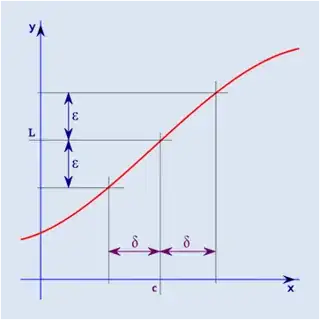
Picture

By changing the condition $0<\vert x-c\vert<\delta$ to $0< x-c<\delta$ we get the definition for the right hand limit, notation: $\lim\limits_{x\downarrow c}$, or $\lim\limits_{x\to c^+}$. Similarly, the definition for the left hand limit (notation: $\lim\limits_{x\uparrow c}$ or $\lim\limits_{x\to c^-}$) can be acquired by changing to $0< c-x<\delta$.

In the definition we explicitly stay away from the case $x=c$. This is because we don't require that $f(c)$ be defined.

This definition can very naturally be generalized to the case where $f:(X,d_X)\to (Y,d_Y)$ is a function between metric spaces. Here we have this:

Suppose that $f: D\to Y$, where $D$ is a subset of $X$ and that $c$ is a limit point of $D$. Now we say that $\lim\limits_{x\to c}f(x)=y$ when $\forall \varepsilon>0~\exists \delta>0$, such that $0<d_X(x,c)<\delta\implies d_Y\big(f(x),y\big)<\varepsilon$, for every $x\in D$.

The notion of the $\varepsilon$-$\delta$ definition of a limit or of continuity does not extend to general topological spaces.

The definition of limit of a sequence on a metric space is:

Suppose that $(x_n)_{n\in\Bbb N}$ is a sequence of elements of a metric space $(X,d)$ and that $l\in X$. Then $l$ is the limit of the sequence if $$(\forall\varepsilon>0)(\exists N\in\Bbb N)(\forall n\in\Bbb N):n\geqslant N\implies d(x_n,l)<\varepsilon.$$

2881 questions
2
votes
2 answers

Epsilon-delta proof

Suppose $\epsilon> 0$ and $\displaystyle\delta = \min \left\{1,\frac{\epsilon}{10}\right\}$ If $0 < |x -1 |< \delta$, does this imply $|x^{2}-1|<\epsilon$? I have verified that for $\epsilon=20$, $\delta=1$ and $x=1.9$, it is true. I have also…
stackdsewew
  • 1,047
2
votes
4 answers

Epsilon-delta definition of limit : set an upper bound to delta?

Am I allowed to set an upper bound to delta in the epsilon-delta definition of limit? Why would it still be equivalent to the original definition ? For example, if the function is defined for all $x$ in $\Bbb R$ : $f : D(f) = \Bbb R \rightarrow \Bbb…
Desura
  • 2,011
2
votes
1 answer

Epsilon and Delta proof of $\lim_{x\to0} \frac{2-\sqrt{4-x}}{ x}$

I need to prove $\lim_{x\to0} \frac{2-\sqrt{4-x}}{ x}$ I first found the limit to be $\frac{1}{4}$ by using l'hopital's rule. By definition i need to find a $\delta > 0$ for every $\epsilon >0$ Then i will have $|x-0|<\delta$ and…
ThisLax
  • 23
2
votes
1 answer

Delta-Epsilon proof of a non-linear function

Suppose we want to prove $\lim_{x \to 2} g(x) = 4$ and $g(x) = x^2$ So we need to show for all $\epsilon > 0 \space \exists \space \delta>0$ such that $0<|x-2|<\delta \implies |g(x) - 4| < \epsilon$ to complete this proof. I am having difficulty in…
elbarto
  • 3,356
1
vote
1 answer

$\epsilon - \delta$ problem

Let $a \in ( -\infty, \infty)$. Suppose $\lim_{x \rightarrow a} f(x) = L \neq0$. Use the $\epsilon-\delta$ argument to prove $$\lim_{x\rightarrow a} \frac{1}{f(x)}= \frac{1}{L}.$$ I know proof should include below but i cannot…
fbg
  • 861
1
vote
1 answer

Cannot understand Courant's proof in his book

On pages 327 and 328 in R. Courant's book What Is Mathematics the global continuity of the function $x \to \frac{1}{1+x^{2}}$ is shown. But I don't understand that proof which runs essentially as follows: On finding $$|f(x) - f(c)| =…
Yes
  • 20,719
1
vote
2 answers

Functions and inequalities

I have no idea about this question. Please give a hand whoever can. I am a beginner. Let $f(x)= x^2 - 10$. Given $\epsilon > 0$, find the value "$a$" so that $$|x -3 |< \min\{2,a\} \implies |f(x)-10|<\epsilon.$$
1
vote
0 answers

Prof says my epsilon delta proof is wrong because of a misplaced negative, but could it actually be correct?

We had to prove that $\lim_{x \to 1} x^3 = 1$ Starting with $|x^3 - 1| < \epsilon$ By breaking the inequality I got $\sqrt[3]{1 - \epsilon} < x < \sqrt[3]{1 + \epsilon}$ I then put my delta as $\delta = \min({\sqrt[3]{1 - \epsilon} - 1, \sqrt[3]{1 +…
1
vote
3 answers

Prove that $\lim_{x \to 0} x \sin\left(\frac1x\right)=0$

Hi everyone im struggling a bit with this question. I kinda get the idea of epsilon-delta proof, and have seen you can choose $\epsilon = \delta$ I don't get why tho. Could someone explain that to me? Another way I thought of the problem, was to…
Kevz123
  • 31
1
vote
1 answer

Proof that $5x^3$ is continuous in $\mathbb R$

We define function $f(x) = 5x^3$. To prove: $f$ is continuous in x, with $x \in \mathbb R.$ Suppose, $\epsilon > 0,$ we choose $\delta = \frac{\epsilon}{5(3x^2 + |3x| +1)}$, then for all $x \in \mathbb R$, with $|x - c| \lt \delta$, we have $|5x^3 -…
1
vote
1 answer

Prove $\lim_{n\to\infty} \frac{n^2 + n + 1} {2n^2 - 4}= 1/2$ by definition

I need to find $n_\epsilon$ such that for $\forall n \geq n_\epsilon : | x_n - \frac{1}{2} | < \epsilon$. So let's do that. $$| \frac{n^2 + n + 1} {2\cdot(n^2 - 2)} - \frac{1}{2} | < \epsilon $$ $$| \frac{n + 3} {2\cdot(n^2 - 2)} | < \epsilon…
1
vote
2 answers

Question about checking my understanding of the epsilon-delta proof.

My understanding of an epsilon-delta proof is that the purpose is to prove that, regarding the above statement to be proven (e.g. Prove that $\lim_{x\to2} 3x - 3 = 3$.), for every $\epsilon$ > 0, that there exists some corresponding value of…
1
vote
1 answer

State each of the following English sentences in symbols

State each of the following English sentences in symbols, as its final form, not containing $\lnot$. (a): $f$ is not continuous at $a$ (b): The sequence $(a_n)_{n \in \mathbb{N}}$ approaches to $\infty$ as $n$ increases. (c): $\lnot$(b) Since i…
John. P
  • 583
1
vote
1 answer

$\lim\limits_{x\to a} f(x)=L$ then $\lim\limits_{x\to (a+c)} f(x-c)=L$ by using $\epsilon-\delta$ definition.

My attempt: Since $f$ has a limit at $x=a$. $\forall \epsilon>0$, $\exists \delta_0>0$ such that for all $x\in Dom(f(x))$ $$\delta_0>|x-a|\quad \text{implies}\quad \epsilon>|f(x)-L|$$ Why can't I just put $x=x-c$ because definiton says that it works…
1
vote
2 answers

using epsilon delta definition to proof limits

$$\lim_{\large x \to 1^+} \frac{2x+3}{x-1}=∞$$ let $$f(x)=\frac{2x+3}{x-1}$$ then $\forall M∈ℝ>0, \exists\delta>0,\forall x\in D_f \left( 0 < \left|x-1 \right|=x-1<\delta\Longrightarrow…
Absurd
  • 369
  • 1
  • 14