Questions tagged [epsilon-delta]

For questions regarding $\varepsilon$-$\delta$ definitions of limits, continuity of functions and $\varepsilon-N$ definition of limit of sequences.

The $\varepsilon$-$\delta$ definition of limit of a function is usually first introduced as follows:

Suppose $f(x)$ is a function from $D$ to $\mathbb R$, where $D$ is a subset of $\mathbb R$. If $\forall \varepsilon>0 ~ \exists \delta>0$, such that $0<\vert x-c\vert <\delta\implies \vert f(x)-L\vert<\varepsilon$ for all $x\in D$, then the limit of $f(x)$ at $x=c$ is $L$. Notation: $\lim\limits_{x\to c}f(x)=L$.

Geometrically, this means that if we stay on the graph of $f$, the value of $f(x)$ will be within a distance of $\varepsilon$ from $L$, as long as the distance between $x$ and $c$ is smaller than $\delta$. (See picture.)
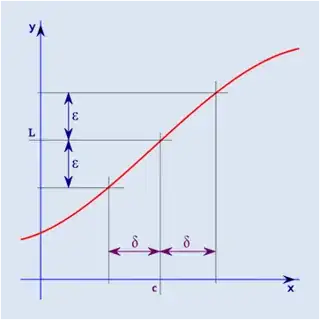
Picture

By changing the condition $0<\vert x-c\vert<\delta$ to $0< x-c<\delta$ we get the definition for the right hand limit, notation: $\lim\limits_{x\downarrow c}$, or $\lim\limits_{x\to c^+}$. Similarly, the definition for the left hand limit (notation: $\lim\limits_{x\uparrow c}$ or $\lim\limits_{x\to c^-}$) can be acquired by changing to $0< c-x<\delta$.

In the definition we explicitly stay away from the case $x=c$. This is because we don't require that $f(c)$ be defined.

This definition can very naturally be generalized to the case where $f:(X,d_X)\to (Y,d_Y)$ is a function between metric spaces. Here we have this:

Suppose that $f: D\to Y$, where $D$ is a subset of $X$ and that $c$ is a limit point of $D$. Now we say that $\lim\limits_{x\to c}f(x)=y$ when $\forall \varepsilon>0~\exists \delta>0$, such that $0<d_X(x,c)<\delta\implies d_Y\big(f(x),y\big)<\varepsilon$, for every $x\in D$.

The notion of the $\varepsilon$-$\delta$ definition of a limit or of continuity does not extend to general topological spaces.

The definition of limit of a sequence on a metric space is:

Suppose that $(x_n)_{n\in\Bbb N}$ is a sequence of elements of a metric space $(X,d)$ and that $l\in X$. Then $l$ is the limit of the sequence if $$(\forall\varepsilon>0)(\exists N\in\Bbb N)(\forall n\in\Bbb N):n\geqslant N\implies d(x_n,l)<\varepsilon.$$

2881 questions
1
vote
1 answer

proof the given limit using epsilon delta definition

$$\lim_{x \to 1} \frac{\sqrt{x}-1}{x-1}=\frac{1}{2}$$ let $$f(x)=\frac{\sqrt{x}-1}{x-1}$$ then $\forall \epsilon>0, \exists\delta>0,\forall x\in D_f \left(\left|x-1 \right|<\delta\Longrightarrow…
Absurd
  • 369
  • 1
  • 14
1
vote
2 answers

finding limit of a given function using epsilon-delta definition

$$\lim_{x \to 1} \frac{1+x}{\left(5x-3\right)\left(1+x^{2}\right)}=\frac{1}{2}$$ let $$f(x)=\frac{1+x}{\left(5x-3\right)\left(1+x^{2}\right)}$$ then $\forall \epsilon>0, \exists\delta>0,\forall x\in D_f…
Absurd
  • 369
  • 1
  • 14
1
vote
1 answer

Convergence of complex sequences: direct proof or using sandwich theorem?

My lecture notes prove the following statement A complex valued sequence $(z_n)_{n\in\mathbb{N}} = (a_n+ib_n)_{n\in\mathbb{N}}$ is convergent to $L = A+iB \in\mathbb{C}$ if and only if $(a_n)$ and $(b_n)$ are convergent. The lecturer's proof…
Benjamin
  • 1,211
1
vote
1 answer

$\epsilon - \delta$ proof for $\frac{x^2 - 16}{x + sin x}$ limit

I'm having difficulty writing an $\epsilon - \delta$ proof for the following limit: $\lim_{x\to 4} \frac{x^2-16}{x+\sin x} = 0$ I've factored it to $\frac{(x+4)(x-4)}{x+\sin x} = 0$ and guessed that I need $\delta = \frac{2}{5}\epsilon$ for $|x-4| <…
Dennis
  • 25
1
vote
2 answers

Find Delta for given limit of function

I have : $$\lim_{x \to-2}\frac{3x+6}{x^3+8} = \frac{1}{4}$$ This is what i've come up with so far : $$|f(x) - L| = \frac{3x+6}{x^3+8} -\frac{1}{4}| =|\frac{12x+24}{4x^3+32} -\frac{x^3+8}{4x^3+32}| = |\frac{-x^3+12x+16}{4x^3+32}|$$ I am looking for a…
1
vote
2 answers

Relating $x$ and $\delta$ in Epsilon Delta proofs

Knowing $\lvert x-b\rvert < n$. Is there any way of having $\lvert x^k-b^k \rvert$ less than something in terms of $n$ rather than $x$? (i.e. $\lvert x^k-b^k \rvert < \lvert n^k-b^k\rvert$) This is part of an epsilon delta proof I am having trouble…
user400098
1
vote
2 answers

prove the limit of this 2-variable quadratic form using ε- δ definition

I have to prove using (ε,δ)-definition of limit: $$ \lim_{(x,y) \to (7,2)} (x^2+y^2-xy) = 39 $$ I have already used the (ε,δ)-definition for simpler proofs in one variable and a few in two variables. However with this one I´ve been thinking all…
Berni
  • 23
1
vote
1 answer

Verification of epsilon delta statement

Suppose I have $\epsilon > 0$ and $\delta$ is min of $\left\{1,\frac{\epsilon}{10}\right\}$ If $0< |x-1| < \delta$, is it then true that $|3x-3|< \epsilon$? I am saying yes and here is why. I can deduce that that $0<|3x-3|<3\delta$ , and since…
stackdsewew
  • 1,047
1
vote
1 answer

Proving a friend wrong about continuity

Let $f: \mathbb{R} \rightarrow \mathbb{R}$ be the function defined by the rule that $f(x)=1$ if $x<0$ and $f(x)=2$ if $x \geq 0$. A friend asserts that $f$ is continuous at the point $x=0$, and you of course disagree. A symbolic formulation of your…
Burgundy
  • 2,097
1
vote
0 answers

Epsilon and delta confusion

Let $\delta > 0$ be chosen so that $$\|x - a\| < \delta \Rightarrow \left\vert\frac{\partial^2 f}{\partial x_i \partial x_j}(x) + \frac{\partial ^2 f}{\partial x_i x_j}(a) \right\vert < \epsilon.$$ Then consider $$\vert v^T (D^2 f(x) - D^2f(a))…
1
vote
2 answers

Help needed in the details of proving continuity for the function $f(x)=\frac{1}{x^2}$ on $(0,\infty)$

Here is the example taken from Ross' Elementary Analysis ((*) refers to the $\epsilon$-$\delta$ definition of continuity): Usually it is possible to know what to value to bound $|x-x_0|$ by (usually a natural number). Where is the intuition to let…
Oscar Flores
  • 1,438
  • 2
  • 18
  • 26
0
votes
1 answer

Epsilon-Delta limit proof

Can someone explain what I circled in red here? This is my teacher's work. Why was $x + 1$ replaced and can someone explain the $1 \lt |x-1| \lt 3$ to me? I am really confused and I would like some "baby step" answers.
Elsa
  • 902
  • 1
  • 11
  • 24
0
votes
1 answer

$\epsilon$-$\delta$ proof that $\ln x$ is continuous everywhere on its domain

How to use $\epsilon$-$\delta$ argument to show the global continuity of the function $x \mapsto \ln x$ on its domain? For, if $c$ lies in the domain of $\ln x$ then $|\ln x - \ln c| = |\ln \frac{x}{c}|$. So how to relate the distance between the…
Yes
  • 20,719
0
votes
1 answer

Having trouble with proving $\lim_{z\to0}\frac{(Re(z))^2}{|z|} = 0$ using the epsilon definition

So, I got up to expanding $\frac{(\Re(z))^2}{|z|}$ to $\frac{z^2+2z\overline z + \overline z^2}{4|z|}$ but I don't see other sequences that converge to $0$ to spark inspiration on how to continue. This one has just really thrown me off. Any…
0
votes
1 answer

"Epsilon Delta Definition of Limits"

I was trying to prove $$\lim_{x\to5}\frac{1}{x-3}= \frac{1}{2}$$ i ended up by having these inequalities, $ -1 < |x-3| < 3$ $|x-5|<1$ $|x-5|<2\epsilon$ so now i have $\delta =$min{$1,2\epsilon$}, from here on i tried to prove $|x-5|<…