Questions tagged [epsilon-delta]

For questions regarding $\varepsilon$-$\delta$ definitions of limits, continuity of functions and $\varepsilon-N$ definition of limit of sequences.

The $\varepsilon$-$\delta$ definition of limit of a function is usually first introduced as follows:

Suppose $f(x)$ is a function from $D$ to $\mathbb R$, where $D$ is a subset of $\mathbb R$. If $\forall \varepsilon>0 ~ \exists \delta>0$, such that $0<\vert x-c\vert <\delta\implies \vert f(x)-L\vert<\varepsilon$ for all $x\in D$, then the limit of $f(x)$ at $x=c$ is $L$. Notation: $\lim\limits_{x\to c}f(x)=L$.

Geometrically, this means that if we stay on the graph of $f$, the value of $f(x)$ will be within a distance of $\varepsilon$ from $L$, as long as the distance between $x$ and $c$ is smaller than $\delta$. (See picture.)
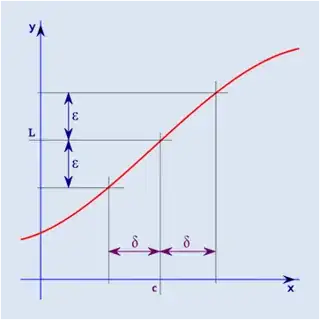
Picture

By changing the condition $0<\vert x-c\vert<\delta$ to $0< x-c<\delta$ we get the definition for the right hand limit, notation: $\lim\limits_{x\downarrow c}$, or $\lim\limits_{x\to c^+}$. Similarly, the definition for the left hand limit (notation: $\lim\limits_{x\uparrow c}$ or $\lim\limits_{x\to c^-}$) can be acquired by changing to $0< c-x<\delta$.

In the definition we explicitly stay away from the case $x=c$. This is because we don't require that $f(c)$ be defined.

This definition can very naturally be generalized to the case where $f:(X,d_X)\to (Y,d_Y)$ is a function between metric spaces. Here we have this:

Suppose that $f: D\to Y$, where $D$ is a subset of $X$ and that $c$ is a limit point of $D$. Now we say that $\lim\limits_{x\to c}f(x)=y$ when $\forall \varepsilon>0~\exists \delta>0$, such that $0<d_X(x,c)<\delta\implies d_Y\big(f(x),y\big)<\varepsilon$, for every $x\in D$.

The notion of the $\varepsilon$-$\delta$ definition of a limit or of continuity does not extend to general topological spaces.

The definition of limit of a sequence on a metric space is:

Suppose that $(x_n)_{n\in\Bbb N}$ is a sequence of elements of a metric space $(X,d)$ and that $l\in X$. Then $l$ is the limit of the sequence if $$(\forall\varepsilon>0)(\exists N\in\Bbb N)(\forall n\in\Bbb N):n\geqslant N\implies d(x_n,l)<\varepsilon.$$

2881 questions
0
votes
1 answer

Prove that $\lim_{x \to 3}{\sqrt{x^2 - x + 3}} =3$ using the precise definition of limits...

I understand that I'm supposed to manipulate the expression of $\lvert f(x) -L \rvert$, i.e. $\left\lvert \sqrt{x^2 - x + 3} - 3 \right\rvert$ to somehow extricate a $\lvert x- a\rvert$, i.e. $\lvert x-3 \rvert$ so that I can express $\delta$ in…
SRSR333
  • 277
0
votes
4 answers

Epsilon-Delta proof: Use the formal definition to verify the indicated limit

I have a question. I have to prove the following limit by epsilon-delta argument. The limit is: $\lim_{x \rightarrow 1}\frac{1}{x+1}=\frac{1}{2}$ I've used the formal definition $0<|x-a|<\delta \Rightarrow |f(x)-L|<\epsilon$. I got (I'm starting…
0
votes
1 answer

Why can't we choose a $\delta$ that depends on $x$?

For example, when asked to prove $$\lim_{x \to 5}(x^2-9) = 16$$ We see that $$|f(x)-L| = |x-5||x+5|$$ My question is, why can't we set $$\delta = \frac{\epsilon}{|x+5|}$$ so that $$|x-5||x+5|<|x+5| \delta$$ $$\implies |x-5||x+5|<|x+5| \cdot…
Vpie649
  • 323
0
votes
1 answer

Confused on why the definition of a limit is the way it is?

We know that the definition of a limit is $\forall\epsilon > 0 \space \exists\delta >0, 0 < |x-c| < \delta \space \to \space |f(x) - L| < \epsilon$ However, won't the definition stay the same if we were to write $\forall\epsilon > 0 \space…
user462562
0
votes
1 answer

$(\epsilon ,\delta)$ Proof of $\lim_{h \to 0} \frac{a^h-1}{h}$ with a >0

to find the $$\lim_{h \to 0} \frac{a^h-1}{h}$$ $ a \in \mathbb{R} $ and a >0 I know that the limit of $\lim_{h \to 0} \frac{a^h-1}{h} = ln(a) $ because $ \lim_{h \to 0} \frac{a^h-1}{h} = f'(0) $ with f(x) = $ {a^x}$ , and f'(x) = ${a^x}…
Mohbenay
  • 382
  • 1
  • 14
0
votes
1 answer

Quesiton about this epsilon-delta proof

This was posted in another question and below is the link. Prove Theorem 2.5(iii), namely, that if $f$ is continuous at $a$ and $λ$ is a scalar, then $λ⋅f$ is continuous at $a$ i.e. $$0<|x−a|<δ⇒|λf(x)−λf(a)|<\varepsilon$$ Here…
stackdsewew
  • 1,047
0
votes
1 answer

verification- epsilon-delta

Suppose $\epsilon$ > 0 and $\delta$ = min {1,$\frac{\epsilon}{10}$} Is it true that if 0 < |x -1 |< $\delta$, then this implies 0 < |x -2 |< $\epsilon$? I am saying yes and here is why. We are given that 0 < |x -1 |< $\delta$, so -1 < |x -2 |<…
stackdsewew
  • 1,047
0
votes
1 answer

Epsilon-delta verification.

Given $\epsilon$>0, and we choose $\delta$ =min of $\left\{1,\frac{\epsilon}{9}\right\}$ Then is it true that if 0 < |x-1|< $\delta$, then |x$^2$-1|< $\epsilon$.> Now |x$^2$-1| <$\epsilon$ is |x+1||x-1| < $\epsilon$ And I know that if 0 < |x-1|<…
stackdsewew
  • 1,047
0
votes
2 answers

Proof of Sum Laws by Epsilon Delta Definition

Supposed I have $\lim_{x \to a}f(x)=-\infty.$ and $\lim_{x \to a}g(x)=c.$ Prove that $\lim_{x \to a}(f(x)+g(x))=-\infty.$ By the epsilon delta definition I know that for every $M<0$, i have: $f(x)
Soby
  • 1,482
0
votes
1 answer

Epsilon delta for absolute value proof

If $x,z$ $\epsilon$ $R$, show that for every $\epsilon >0$ there is a $\delta > 0$ such that if $y$ $\epsilon$ $R$ satisfies $|y-x|< \delta$ then $|zy - xz| < \epsilon$. So I tried to take $\epsilon =1$ and I tried to solve from there, but I…
0
votes
2 answers

how to find epsilon-delta definition of a limit

Use epsilon-delta definition of limit To show : $\displaystyle \lim_{x \to 0} x\sin \left(\dfrac{1}{x}\right) = 0$ How to explain this in detail with step by step explanations?
rohit
  • 371
-1
votes
3 answers

Prove $\lim_{(x,y)\to(0,0)} \frac{xy^2}{x^2+y}$

Prove $\lim_{(x,y)\to(0,0)} \frac{xy^2}{x^2+y}=0$ using epsilon-delta proof. I tried to solve this problem with epsilon-delta method, but couldn't handle it. anyone help me?
-1
votes
1 answer

Epsilon Delta proof containing decimal exponents

so I have to prove lim x->infinity ((x^0.8)/(1+x^0.9)) = 0 I am just introduced to epsilon delta, and have no idea how to do this. Please help :( Thanks!
-1
votes
1 answer

Proving $\lim_{x \rightarrow a} \frac{1}{x} = \frac{1}{a}$ by use of limit definition

$$ \frac{-|x-a|}{a|x|} < \varepsilon $$ Then i did was assume $\delta = a/2$ and got the values where $x \in (a/2,3a/2)$. Idk what to do next and im sorry idk how to format.
Bob
  • 25
  • 8
-2
votes
1 answer

ϵ-δ proof that $\lim_{x\to 2} \frac{1}{x} = \frac{1}{2}$

I've been doing some practice and for some reason I've been baffled by this since I get stuck on some point every time I restart. I've been doing some practice and for some reason I've been baffled by this since I get stuck on some point every time…
Eren O.
  • 23