Questions tagged [epsilon-delta]

For questions regarding $\varepsilon$-$\delta$ definitions of limits, continuity of functions and $\varepsilon-N$ definition of limit of sequences.

The $\varepsilon$-$\delta$ definition of limit of a function is usually first introduced as follows:

Suppose $f(x)$ is a function from $D$ to $\mathbb R$, where $D$ is a subset of $\mathbb R$. If $\forall \varepsilon>0 ~ \exists \delta>0$, such that $0<\vert x-c\vert <\delta\implies \vert f(x)-L\vert<\varepsilon$ for all $x\in D$, then the limit of $f(x)$ at $x=c$ is $L$. Notation: $\lim\limits_{x\to c}f(x)=L$.

Geometrically, this means that if we stay on the graph of $f$, the value of $f(x)$ will be within a distance of $\varepsilon$ from $L$, as long as the distance between $x$ and $c$ is smaller than $\delta$. (See picture.)
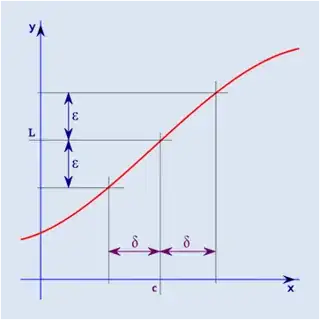
Picture

By changing the condition $0<\vert x-c\vert<\delta$ to $0< x-c<\delta$ we get the definition for the right hand limit, notation: $\lim\limits_{x\downarrow c}$, or $\lim\limits_{x\to c^+}$. Similarly, the definition for the left hand limit (notation: $\lim\limits_{x\uparrow c}$ or $\lim\limits_{x\to c^-}$) can be acquired by changing to $0< c-x<\delta$.

In the definition we explicitly stay away from the case $x=c$. This is because we don't require that $f(c)$ be defined.

This definition can very naturally be generalized to the case where $f:(X,d_X)\to (Y,d_Y)$ is a function between metric spaces. Here we have this:

Suppose that $f: D\to Y$, where $D$ is a subset of $X$ and that $c$ is a limit point of $D$. Now we say that $\lim\limits_{x\to c}f(x)=y$ when $\forall \varepsilon>0~\exists \delta>0$, such that $0<d_X(x,c)<\delta\implies d_Y\big(f(x),y\big)<\varepsilon$, for every $x\in D$.

The notion of the $\varepsilon$-$\delta$ definition of a limit or of continuity does not extend to general topological spaces.

The definition of limit of a sequence on a metric space is:

Suppose that $(x_n)_{n\in\Bbb N}$ is a sequence of elements of a metric space $(X,d)$ and that $l\in X$. Then $l$ is the limit of the sequence if $$(\forall\varepsilon>0)(\exists N\in\Bbb N)(\forall n\in\Bbb N):n\geqslant N\implies d(x_n,l)<\varepsilon.$$

2881 questions
0
votes
2 answers

Confusion with $ \epsilon$-$\delta $ definition.

In delta-epsilon definition of limit what I understand is that for whatever small value of $ \epsilon $ is chosen if the corresponding $ \delta$ is found then the existence of the limit is confirmed. But the problem is that we are not sure how big…
0
votes
1 answer

Choosing $x$ to prove a function is discontinuous

I am trying to show, using the epsilon-delta definition of the limit, that the function $$f(x) = \begin{cases}1 & \text{if $x = 0$}\\x & \text{if $x \neq 0$}\end{cases}$$ is discontinuous at $x = 0$. We want to show that $$\exists \varepsilon >…
0
votes
1 answer

Using the epsilon delta criterion to show discontinuity in a point

I am working on the following exercise: Use the $\epsilon-\delta$-criterion to show that the following function is discontinuous in $0\\$ $sgn(x) = \begin{cases} -1&,\text{ for }x<0\\ 0&,\text{ for }x=0 \\ 1&,\text{…
0
votes
2 answers

Epsilon delta proof of nested sine function

I know that $\lim_{x->0}f(x)=\pi$ and $\lim_{x->\pi}\sin(x)=0$. I have to prove that $\lim_{x->\pi}f(\sin(x))=\pi$ using the epsilon delta proof. My idea was to use the value of $\delta=MAX(\delta_1,\delta_2)$ where $0<|x|<\delta_1$ and…
0
votes
2 answers

In epsilon n proofs, how is the index of the sequence related to the expression n>N

I was attempting to understand an epsilon n proof when this was the stated chain of implications: $$\forall \epsilon > 0, \exists N_2 > 1 : n + 1 \geq N_2 \implies | c_n - L | < \epsilon$$ Then: $$\forall \epsilon > 0, \exists N_2 > 1 : n \geq N_2…
William
  • 517
0
votes
1 answer

Understanding Why $\lvert{x}\rvert < \min\{1,\delta\}$ in Spivak's Solutions.

I am working my way through Spivak. I am not incredibly confident in my solution to the problem, and the solutions in the back of the book gives a subtlety that I don't have in my own proof. I'm wondering why. Claim: $\lim_{x \to 0} f(x) = \lim_{x…
0
votes
1 answer

Epsilon delta proof, choosing inequality side

I have to prove the following using epsilon delta: $$\lim\limits_{x \to -2} x^3+4x^2+4x-1 = -1$$ if $|x+2| < \delta$ then $|f(x) - f(a)| < \varepsilon$ Factorizing f(x): $|(x+2)(x^2+2x)| < \varepsilon$ Divide both sides by $|x^2+2x|$ and get: $|x+2|…
eh98
  • 1
0
votes
2 answers

Proving limit to infinity using epsilon-delta definition.

Given the following limit to infinity, I am supposed to prove using epsilon-delta definition that the limit = 3 as x approaches infinity. How do I approach this? $$\lim_{x\to\infty}\dfrac{6x+1}{2x+1} = 3$$
Naja
  • 23
0
votes
2 answers

About the proof using a simple epsilon delta.

Explanation I want to prove this equation (1) using the $\epsilon-\delta$ definition for the function $f(x) = x^2$. $$ \lim_{x \to a} f(x) = a^2 \tag{1} $$ I've read certain books and I don't agree with some of them. In that book, $\delta$ was…
tan
  • 103
0
votes
1 answer

Epsilon-delta on a function with restricted range

On James Stewart's Calculus Early transcendental it says: The definition of limit says that if any small interval $(L - \epsilon , L + \epsilon)$ is given around $L$, then we can find an interval $(a - \delta, a + \delta)$ around a such that $f$…
user716881
0
votes
2 answers

Intuition behind being able to choose many different deltas when proving with epsilon delta limits

https://brilliant.org/wiki/epsilon-delta-definition-of-a-limit/ In the section of the page wherre they prove $\lim_{x \to \pi} x = \pi$ , they say there are many different deltas we could choose given an epsilon. Why is this? I thought when you…
0
votes
1 answer

Relationship between slope of $mx+b$ and the $\epsilon-\delta$ definition of limit

I just want to make sure that is this idea is true for all $y=mx+b$ cases: for a line of slope $m$, then $\delta=\frac{\epsilon}{\left|m\right|}$ (or "could at most equal"). In other words, the steeper the line, the smaller $\delta$ is to $\epsilon$
user612996
0
votes
4 answers

Prove using epsilon delta definition that $\lim_{x\rightarrow1}f(x) = 3$ when $f(x) = \frac{x^3 - 1}{x-1}$.

I get to the point where I get (x+2)(x-1) is less than epsilon and do not know how to proceed just tell me a hint since I want to do it myself
0
votes
4 answers

$\epsilon - \delta$ proof. Need help

I have been knocking my head against this proof for an hour now and I'm no closer to solving it. I simply have no idea where to go. The thing I need to prove is, given $$f(x)=\frac{2x+3}{x+1},$$ show that $f(x)\to 3$ for $x\to 0$. I have tried to…
VictorVH
  • 481
0
votes
1 answer

How to find the delta for the following problem?

Let $f(x, y) = \begin{cases} \frac{2x^4y-5x^2y^2+y^5}{(x^2+y^2)^2}, \ (x, y) \neq (0, 0) \\ 0, \qquad \qquad \qquad (x, y) = (0,0 ) \end{cases}$. Find a $\delta > 0$ such that $|f(x, y)-f(0, 0)| < 0.1$ whenever $\sqrt{x^2+y^2} < \delta$. Use polar…
PAMG
  • 4,440